Today's
EarthStation1.com 15% Off Commemorative Memorial Title: Helen
Keller: In Her Story + Bonus Biography DVD, Download, USB Drive
Today, June 28, 2026
June 27: Helen Keller Day: -- June 27,
1880: #BOTD: #HBD! Helen Keller, American author, political
activist, academic and lecturer (d. 1968) is #born Helen Adams
Keller, in Tuscumbia, Alabama, the daughter of Arthur Henley
Keller (1836-1896),[7] and Catherine Everett (Adams) Keller
(1856-1921), known as "Kate". Helen Keller was the first
deaf-blind person to earn a bachelor of arts degree. The story of
how Keller's teacher, Anne Sullivan, broke through the isolation
imposed by a near complete lack of language, allowing the girl to
blossom as she learned to communicate, has become widely known
through the dramatic depictions of the play and film The Miracle
Worker. Her birthplace in West Tuscumbia, Alabama, is now a museum
and sponsors an annual "Helen Keller Day". Her birthday
on June 27 is commemorated as Helen Keller Day in the U.S. state
of Pennsylvania and was authorized at the federal level by
presidential proclamation by President Jimmy Carter in 1980, the
100th anniversary of her birth. A prolific author, Keller was
well-traveled and outspoken in her convictions. A member of the
Socialist Party of America and the Industrial Workers of the
World, she campaigned for women's suffrage, labor rights,
socialism, antimilitarism, and other similar causes. Keller proved
to the world that deaf people could all learn to communicate and
that they could survive in the hearing world. She also taught that
deaf people are capable of doing things that hearing people can
do. One of the most famous deaf people in history, she is a role
model to many deaf people in the world. #HelenKeller #
Deafblindness #Deafness #Blindness #RoleModels #AnneSullivan
#TheMiracleWorker #TuscumbiaAlabama #SocialistPartyOfAmerica
#DemocraticSocialism #SocialDemocracy (Sell Helen Keller )
#IndustrialWorkersOfTheWorld #IWW #Wobblies #WomensSuffrage
#LaborRights #Socialism #Antimilitarism #MP4 #VideoDownload #DVD
On Sale @ 15% Off Discount Till Midnight PT!
https://store.earthstation1.com/helen-keller-in-her-story-dvd-plus-bonus-biography.html
Today's
EarthStation1.com 15% Off Commemorative Memorial Title: Jack Benny
Complete Radio Broadcasts Set MP3 DVD, Audio Download, USB
Today, June 28, 2026
June 27: National Onion Day: -- Through
all the years - and sometimes tears - National Onion Day on June
27th recognizes the flavor and aroma the bulb of the allium family
brings to numerous recipes. Whether we choose a sweet, white, red,
or the ever-favorite yellow, we count on the onion to enhance the
flavor of our savory recipes. They pair well with meats and
salads, making the versatile onion a cooking powerhouse. Added to
eggs or pickled, it's the required seasoning next to our salt and
pepper. While the onion packs in the flavor with very few
calories, it's also rich in vitamin C and antioxidants. Add onions
to every meal to increase your dietary fiber and vitamin B6. As a
bonus, you won't be adding any cholesterol. With so many varieties
to choose from, onions provide plenty of opportunities for us to
relish the benefits. Although we cook with onions for the flavor
punch, they also serve up an economic boost, too. As an industry,
onions add 6B USD to American markets. From farm to distribution
to grocers and restaurants, onions generate economic growth
throughout the year. To observe National Onion Day, be sure to add
fresh onion for a punch of flavor to your favorite dish. No matter
how you slice it, the onion brings some of the best flavors
together! Whether you like to caramelize it or pickle it, tell the
world how you love to cook with onions by using #NationalOnionDay
to share your best recipes and tips on social media! The National
Onion Association founded National Onion Day on June 27, 2019, to
honor the anniversary of the association. They represent almost
500 onion growers, shippers, packers, and associated members
across the country, and they officially incorporated on June 27,
1913, in Ohio. The association celebrated its 100th anniversary in
2013. #OnionDay #Onions #Yum #NationalDays #MP3 #CD #AudioDownload
On Sale @ 15% Off Discount Till Midnight PT!
https://store.earthstation1.com/jack-benny-complete-radio-broadcasts-dual-layer-mp3-dv3.html
Today's
EarthStation1.com 15% Off Commemorative Memorial Title: Jean
Shepherd Radio Shows All Known To Exist DVD, MP3 Download, USB
Today, June 28, 2026
June 27: National Sunglasses Day: -- Pop
on your favorite sunglasses and protect your eyes from the harsh
light of day, protect your forehead from squint-based wrinkles,
and look cool doing it. Elton John has over a thousand pairs,
Canadian singer Corey Hart only wears his at night, and you can
tell the good guys from the bad guys in The Matrix by the shape of
theirs. What is this conversation really about? Sunglasses, of
course. There's nothing quite as stylish as a pair of shades, so
get out those aviators or wayfarers and start celebrating National
Sunglasses Day! While many people might believe that sunglasses
are a fairly modern invention, that would actually be incorrect.
In fact, the history of sunglasses may stretch as far back as 14th
century China, where the story goes that judges of the time would
use eyewear made of smoke-colored quartz to mask their emotions
when listening to cases. Fast-forward 600 years and modern
sunglasses as they are known today began to develop. In the late
19th century, doctors began experimenting with amber or brown
tinted lenses on glasses, specifically for people who had
syphilis, a symptom of which is sensitivity to light. It wasn't
until 1929 when mass produced sunglasses were first marketed by
entrepreneur Sam Foster on the beaches by the Atlantic City
Boardwalk, that they began to be affordable and average people
started to use them. From then, the concept of sunglasses becoming
a "cool" style was confirmed and this fashion accessory
has just continued to grow in popularity. From driving vehicles on
land to piloting airplanes, sunglasses also allow the operators to
not only look cool, but also to be able to have much clearer
vision regarding where they are going, acting as a safety
precaution for better performance and steering. National
Sunglasses Day got its start in recent years when it was organized
by The Vision Council, which is a nonprofit trade association for
those in the optical industry, who suggested establishing the day
to remind people to take good care of the health of their eyes.
And because the longest days of the year happen toward the end of
the month of June, it only makes sense that National Sunglasses
Day would be scheduled at a time when the eyes are at most risk of
damage from the long hours of sunlight. #SunglassesDay #Sunglasses
#NationalDays #MP3 #AudioDownload #DVD On Sale @ 15% Off Discount
Till Midnight PT!
https://store.earthstation1.com/complete-jean-shepherd-radio-and-lp-collection-mp3-dvds-2-dis32.html
Today's
EarthStation1.com 15% Off Commemorative Memorial Title: Soldiers
In Hiding Vietnam Vets Who Live In Wilderness DVD, MP4, USB
Today, June 28, 2026
June 27: National PTSD Awareness Day:
Today we talk about PTSD, a complex disorder caused by
experiencing or witnessing trauma. The trauma necessary to cause
PTSD can originate from many events - potentially an accident,
combat, a natural disaster, or an assault - but there are other
ways PTSD symptoms can arise. A trained professional must diagnose
PTSD, based on symptoms like hypervigilance, mood swings,
recurring and involuntary flashbacks to the trauma, and avoidance.
The National Center for PTSD declared all of June to be PTSD
Awareness month - you can help their campaign by educating
yourself and others about the illness, and sharing help with those
who might need it. PTSD in some form or another has long been
documented in humans. The earliest known literature about the
disorder is a poem from 50 BC. Hippocrates narrated a traumatic
battle experience about a soldier who was haunted by PTSD-like
combat flashbacks. PTSD has consistently been mentioned since
then, notably during the Hundred Year's War between England and
France, and even in the literature of Shakespeare - including
Romeo and Juliet. A new understanding of PTSD came with the Civil
War in the 1800s, as the disorder became widespread in the
traumatized country. PTSD was known under a variety of names,
including "railway spine." It was in 1915 that some
understanding of PTSD was formally introduced into medical
literature, under the name "shell shock." World War 1
threw the disease into the spotlight, and rudimentary treatments,
like electric shock therapy, were attempted. It wasn't until the
1950s that more modern treatments, like group therapy, were
introduced. The Vietnam War issued in, yet again, a new
understanding of the disorder. This coincided with research done
by psychologists on both Holocaust victims and rape victims, which
helped prove that many kinds of trauma can lead to PTSD. Today,
it's considered largely treatable, so we've made a lot of
progress. The Senate recognized June 27 as National PTSD Awareness
Day at the urging of Senator Kent Conrad. Conrad wanted to honor a
North Dakota National Guard member who had committed suicide after
two tours of duty in Iraq. In 2014, the entire month of June was
designated National PTSD Awareness Month by the Senate. On Sale @
15% Off Discount Till Midnight PT!
https://store.earthstation1.com/soldiers-in-hiding-dvd-vietnam-vets-who-live-in-the-wilderness.html
Today's
EarthStation1.com 15% Off Commemorative Memorial Title: Soldiers:
A History Of Men In Battle TV Series + Bonus Title DVD MP4
Today, June 28, 2026
June 27, 1838: #BOTD: #HBD: Paul Mauser,
German engineer, weapon designer, manufacturer, industrialist and
politician who made signficant contributions to gun design and
manufacture (d. May 29, 1914) is #born Peter Paul von Mauser in
Oberndorf am Neckar, in what was then the Kingdom of Wurttemberg.
He and his brother Wilhelm both became gunsmiths, and the two
developed various firearms and founded the company Gebr Mauser,
which finally took over from the royal manufacture. Together with
his brother Wilhelm Mauser, Peter Paul Mauser designed the Mauser
Model 1871 rifle, the first of a successful line of Mauser rifles
and pistols. The rifle was adopted as the Gewehr 71 or
Infanterie-Gewehr 71 and was the first metal cartridge weapon of
the German Empire. While Wilhelm handled the business side of the
factory, Paul proved to be the more technically capable engineer,
and he made significant contributions to bolt action rifle design
and successfully combined and improved various bolt action
engineering concepts. The Mauser company bolt action development
resulted in the Gewehr 98 and Karabiner 98k rifle series that were
the latest in a line of Mauser bolt-action rifles that started
with the Mauser Model 1889 and were adapted in 1889 and the 1890s
as service rifles by several countries. The bolt-action design
used for the Gewehr 98 was patented by Paul Mauser on September 9,
1895. Besides rifles, Paul Mauser also developed handguns, with
the first Mauser designed handgun being the Mauser C78 revolver.
In 1896, Paul Mauser would develop the C96 pistol, which was one
of the first semi-automatic pistols in history. Initially,
Mauser's designs were more successful abroad than in Prussia, but
the Prussian Rifle Review Board in Spandau opted for the
domestically developed 1888 rifle. Mauser designed an improved
model of this rifle for the Imperial Order . The name of Mauser is
inseparable from the construction of the 1893 infantry rifle for
Spain, 1894 carbine and 1896 infantry rifle for Sweden, with model
rifles for Peru, Belgium, Argentina, the Brazil (1894), Chile
(1895), then Costa Rica, the Dominican Republic, El Salvador,
Guatemala, Honduras, Nicaragua, Venezuela, Mexico (1902), Uruguay
and Turkey. Deliveries to these countries make the Mauser name a
world-renowned guarantee of quality for precise weapons. The
construction of the Gewehr 98 rifle was personally praised by
Kaiser Wilhelm II on April 5, 1898. Mauser lost his left eye in
1901 as a result of a cartridge explosion during a test firing of
the self-loading C98. Mauser also designed the 7.65_53mm Mauser
(1889) and 7_57mm Mauser (1892) rifle cartridges. These cartridges
were high-performance service cartridge designs compared to other
contemporary smokeless powder service cartridges such as the 8mm
Lebel (1886), 8_50mmR Mannlicher (1890) and .303 British (1891).
Mauser was a member of the German Reichstag for the National
Liberal Party from 1898 to 1903, a party that appeared in the
Kingdom of Wurttemberg as a German party. In the Reichstag, he
represents the 8th district of Wurttemberg (Freudenstadt, Horb,
Oberndorf, and Sulz). He was nominated as a candidate thanks to an
alliance of the Conservatives, the Farmers' Federation, and the
National Liberals and after his election to the Reichstag he
joined the Group of National Liberals as a guest. Peter Paul von
Mauser died aged 75 in Oberndorf am Neckar, German Empire, 2
months before World War 1 started. He is buried at Oberndorf
Valley Cemetery in Oberndorf am Neckar. On Sale @ 15% Off Discount
Till Midnight PT!
https://store.earthstation1.com/soldiers-a-history-of-men-in-battle-4-dvds-all-13-sh413.html
Today's
EarthStation1.com 15% Off Commemorative Memorial Title: Is There
One Who Understands Me? The World Of James Joyce DVD MP4 USB
Today, June 28, 2026
June 27, 1846: #BOTD: #HBD! Charles
Stewart Parnell, Irish nationalist politician who served as a
Member of Parliament (MP) in the United Kingdom from 1875 to 1891,
Leader of the Home Rule League from 1880 to 1882, and then of the
Irish Parliamentary Party from 1882 to 1891, who held the balance
of power in the House of Commons during the Home Rule debates of
1885-1886 (d. October 6, 1891) is #born in Avondale House, County
Wicklow into a powerful Anglo-Irish Protestant landowning family
in County Wicklow, the third son and seventh child of John Henry
Parnell (1811-1859), a wealthy Anglo-Irish Anglican landowner, and
his American wife Delia Tudor Stewart (1816-1898) of Bordentown,
New Jersey, daughter of the stepson of one of George Washington's
bodyguards, American naval hero Admiral Charles Stewart, who saw
service during the Quasi War and both Barbary Wars in the
Mediterranean along North Africa and in the War of 1812,
ultimately becoming commander of the Philadelphia navy yard and
the Navy's first flag officer. His grandson Charles Stewart
Parnell was named after him. There were eleven children in all:
five boys and six girls. Admiral Stewart's mother, Parnell's
great-grandmother, belonged to the Tudor family, so Parnell had a
distant relationship with the British royal family. Charles
Stewart Parnell was a land reform agitator and founder of the
Irish National Land League in 1879. He became leader of the Home
Rule League, operating independently of the Liberal Party, winning
great influence by his balancing of constitutional, radical, and
economic issues, and by his skilful use of parliamentary
procedure. Parnell's newspaper, the United Ireland, attacked the
Land Act, one a series of measures dealing with tenancy contracts
and peasant proprietorship, and he was arrested on October 13,
1881 together with his party lieutenants William O'Brien, John
Dillon, Michael Davitt and Willie Redmond, and was imprisoned in
Kilmainham Gaol, Dublin under one of the many proclaimed Coercion
Acts passed by The House Of Lords. They were charged with
sabotaging the Land Act", from where the No Rent Manifesto,
which Parnell and the others signed, was issued calling for a
national tenant farmer rent strike. The Irish National Land
League, an organization which organised tenant farmers to resist
exactions of landowners of which Parnetl was president, was also
immediately suppressed. Whilst in gaol, Parnell moved in April
1882 to make a deal with the government, negotiated through
Captain William O'Shea MP (with whose wife Parnell was having a
secret love affair, the future Katharine Parnell) that, provided
the government settled the "rent arrears" question
allowing 100,000 tenants to appeal for fair rent before the land
courts, then withdrawing the manifesto and undertaking to move
against agrarian crime, after he concluded that militancy would
never win Home Rule. Parnell also promised to use his good offices
to quell the violence and to cooperate cordially for the future
with the Liberal Party in forwarding Liberal principles and
measures of general reform. This agreement became known as The
Kilmainham Treaty, and Parnell's resulting release from gaol on
May 2 marked a critical turning point in the development of
Parnell's leadership when he returned to the parameters of
parliamentary and constitutional politics, though it also resulted
in the loss of support of the militant American republican Clan na
Gael organisation led by John Devoy. His political diplomacy
preserved the national Home Rule movement after the Phoenix Park
Murders, the fatal stabbings of Lord Frederick Cavendish and
Thomas Henry Burke in Phoenix Park, Dublin on May 6 by members of
a republican organisation known as the Irish National Invincibles,
a more radical breakaway from the Irish Republican Brotherhood
(IRB), a secret oath-bound fraternal organisation dedicated to the
establishment of an "independent democratic republic" in
Ireland between 1858 and 1924. Parnell was so shocked by the
assassinations that he offered to Gladstone his resignation of his
seat as MP. The militant Invincibles responsible fled to the
United States, which allowed him to break links with radical Land
Leaguers. In the end, it resulted in a Parnell - Gladstone
alliance working closely together. Davitt and other prominent
members left the IRB, and many rank-and-file Fenians drifted into
the Home Rule movement. For the next 20 years, the IRB ceased to
be an important force in Irish politics, leaving Parnell and his
party the leaders of the nationalist movement in Ireland. The hung
parliament of 1885 saw him hold the balance of power between
William Gladstone's Liberal Party and Lord Salisbury's
Conservative Party. His power was one factor in Gladstone's
adoption of Home Rule as the central tenet of the Liberal Party.
Parnell's reputation peaked from 1889 to 1890, after letters
published in The Times, linking him to the Phoenix Park killings
of 1882, were shown during the Commission Of Enquiry Parnell had
requested to have been forged by Irish journalist Richard Pigott,
who later shot himself to death in a Madrid, Spain hotel in
disgrace. Parnell then sued The Times for libel, who agreed to an
out of court settlement of 5,000 PS (equivalent to 695,000 PS in
2023) as well as considerably more in legal fees. When Parnell
next entered the House of Commons, he received a hero's reception
from his fellow Members of Parliamen ted by Gladstone. The Irish
Parliamentary Party split in 1890, following the revelation of
Parnell's long adulterous love affair with Katharine "Kitty"
O'Shea, which led to many British Liberals, many of whom were
Nonconformists (Protestant Christians who did not "conform"
to the The Church Of England), refusing to have an adulterer play
a major role in the Liberal Party, and which engendered strong
opposition from Catholic bishops. Captain William O'Shea, who had
negotiated the Kilmainham Treaty had separated from his wife
Katharine O'Shea, sometime around 1875, but would not divorce her
as she was expecting a substantial inheritance. Mrs. O'Shea acted
as liaison in 1885 with Gladstone during proposals for the First
Home Rule Bill. Parnell later took up residence with her in
Eltham, Kent, in the summer of 1886, and was a known overnight
visitor at the O'Shea house in Brockley, Kent. The divoce case
came to trial on November 15, 1890. The two-day trial revealed
that Parnell had been the long-term lover of Mrs. O'Shea and had
fathered three of her children. Meanwhile, Parnell assured the
Irish Party that there was no need to fear the verdict because he
would be exonerated. During January 1890, resolutions of
confidence in his leadership were passed throughout the country.
Parnell, who was a corespondant in the case, did not contest the
divorce action at a November 15 hearing to ensure that it would be
granted so that he could marry Mrs O'Shea, so Captain O'Shea's
allegations went unchallenged. A divorce decree was granted two
days later on November 17, 1890, but Parnell's two surviving
children were placed in O'Shea's custody. News of the
long-standing adultery created a huge public scandal. The Irish
National League passed a resolution to confirm his leadership. The
Catholic Church hierarchy in Ireland was shocked by Parnell's
immorality and feared that he would wreck the cause of Home Rule.
Besides the issue of tolerating immorality, the bishops sought to
keep control of Irish Catholic politics, and they no longer
trusted Parnell as an ally. The chief Catholic leader, Archbishop
Walsh of Dublin, came under heavy pressure from politicians, his
fellow bishops, and Cardinal Manning; Walsh finally declared
against Parnell. For the first time in Irish history, the two
dominant forces of Nationalism and Catholicism came to a parting
of the ways. Gladstone warned that if Parnell retained the
leadership, it would mean the loss of the next election, the end
of their alliance, and also of Home Rule. With Parnell obdurate,
the alliance collapsed in bitterness. When the annual party
leadership election was held on 25 November, Gladstone's warning
was not conveyed to the members until after they had loyally
re-elected their chief in his office. Gladstone published his
warning in a letter the next day; angry members demanded a new
meeting, and this was called for December 1. Parnell issued a
manifesto on November 29, saying a section of the party had lost
its independence; he falsified Gladstone's terms for Home Rule and
said they were inadequate. A total of 73 members were present for
the fateful meeting in committee room 15 at Westminster. Leaders
tried desperately to achieve a compromise in which Parnell would
temporarily withdraw. Parnell refused. He vehemently insisted that
the independence of the Irish party could not be compromised
either by Gladstone or by the Catholic hierarchy. As chairman, he
blocked any motion to remove him. On December 6, after five days
of vehement debate, a majority of 44 present led by Justin
McCarthy walked out to found a new organisation, thus creating
rival Parnellite and anti-Parnellite parties. The minority of 28
who remained true to their embattled Chief continued in the Irish
National League under John Redmond, but all of his former close
associates -- Michael Davitt, John Dillon, William O'Brien and
Timothy Healy -- deserted him to join the anti-Parnellites. The
vast majority of anti-Parnellites formed the Irish National
Federation, later led by John Dillon and supported by the Catholic
Church. The bitterness of the split tore Ireland apart and
resonated well into the next century; Parnell's faction dissipated
after his death, and the majority faction henceforth played only a
minor role in both British or Irish politics until the next time
the UK had a hung Parliament, in 1910 thirty years later. Parnell
fought back desperately, despite his failing health. On December
10, he arrived in Dublin to a hero's welcome. He and his followers
forcibly seized the offices of the party paper United Irishman. A
year before, his prestige had reached new heights, but the new
crisis crippled this support, and most rural nationalists turned
against him. In the December North Kilkenny by-election, he
attracted Fenian "hillside men" to his side. This
ambiguity shocked former adherents, who clashed physically with
his supporters; his candidate lost by almost two to one. Deposed
as leader, he fought a long and fierce campaign for reinstatement.
He conducted a political tour of Ireland to re-establish popular
support. In a North Sligo by-election, the defeat of his candidate
by 2,493 votes to 3,261 was less resounding. He fulfilled his
loyalty to Katharine when they married on June 25, 1891 after
Parnell had unsuccessfully sought a church wedding. On the same
day, the Irish Catholic hierarchy, worried by the number of
priests who had supported him in North Sligo, signed and published
a near-unanimous condemnation: "by his public misconduct, has
utterly disqualified himself to be ... leader." Only Edward
O'Dwyer, bishop of Limerick withheld his signature. The Parnells
then took up residence in Brighton. He returned to fight the third
and last by-election in County Carlow, having lost the support of
the Freeman's Journal when its proprietor Edmund Dwyer-Gray
defected to the anti-Parnellites. At one point quicklime was
thrown at his eyes by a hostile crowd in Castlecomer, County
Kilkenny. Parnell continued the exhausting campaigning. One loss
followed another but he looked to the next general election in
1892 to restore his fortunes. On September 27, he addressed a
crowd in pouring rain at Creggs, subjecting himself to a severe
soaking. On the difficult campaign trail, his health continuously
deteriorated; furthermore, he had kidney disease. Parnell fought
on furiously but, though aged just 45, he was a dying man; he
returned to Dublin on September 30, and he died a week later of
pneumonia in the arms of his wife Katharine at his home at 10
Walsingham Terrace, Hove (now replaced by Dorset Court, Kingsway),
aged 45. Though an Anglican, his funeral on October 11 was at the
Irish National nondenominational Glasnevin Cemetery in Dublin
where he was buried, and was attended by more than 200,000 people.
His grave originally nad no headstone, but rather a flowerbed that
including the spelling of his name "PARNELL", in 1940,
it was replaced in 1940 by a symbolically unhewn Wicklow granite
gravestone, longer than it is wide that likewise reads only
"PARNELL". His brother John Howard inherited the
Avondale estate. He found it heavily mortgaged and eventually sold
it in 1899. Five years later, at the suggestion of Horace
Plunkett, it was purchased by the state. It is open to public view
and is where the "Parnell Society" holds its annual
August summer school. The "Parnell National Memorial Park"
is in nearby Rathdrum, County Wicklow. Dublin has locations named
Parnell Street and Parnell Square. At the north end of O'Connell
Street stands the Parnell Monument. This was planned and organised
by John Redmond, who chose the American Augustus Saint Gaudens to
sculpt the statue; it was funded by Americans and completed in
1911. Art critics said it was not an artistic success. He is also
commemorated on the first Sunday after the anniversary of his
October 6 death, itself known as Ivy Day, which originated when
the mourners at his funeral in 1891, taking their cue from a
wreath of ivy sent by a Cork woman "as the best offering she
could afford", took ivy leaves from the walls and stuck them
in their lapels. Ever after, the ivy leaf became the Parnellite
emblem, worn by his followers when they gathered to honour their
lost leader. Since 1991, the centenary of his death, Magdalene
College, Cambridge, where Parnell studied, has offered the Parnell
Fellowship in Irish Studies, which is awarded to a scholar for up
to a year for study without teaching or administrative
responsibilities. Parnell Fellows have often been historians, but
have spanned a wide range of disciplines. Parnell is celebrated as
the best organiser of an Irish political party up to that time,
and one of the most formidable figures in parliamentary history.
Parnell is a frequent subject in literature, particuarly Irish
literature. He is toasted in the 1938 poem of William Butler
Yeats, "Come Gather Round Me, Parnellites", while he is
also referred to in "To a Shade", where he performs the
famous "C.S.Parnell Style", and in Yeats' two-line poem
"Parnell": "Parnell came down the road, he said to
a cheering man: | 'Ireland shall get her freedom and you still
break stone.'"("breaking stones" is rude slang
meainging to harass, nag, or upbraid one to do, accomplish, or
complete something.) Parnell is the subject of a discussion in
Irish author James Joyce's first chapter of the
semi-autobiographical novel A Portrait of the Artist as a Young
Man, first serialised in The Egoist magazine in 1914-15. Parnell
appears in "Ivy Day in the Committee Room" in Dubliners.
He is also discussed in Ulysses, as is his brother. The main
character in Finnegans Wake, HCE, is partially based on Parnell;
among other resemblances, both are accused of transgressions in
Phoenix Park. The Irish rebel song by Dominic Behan "Come
Out, Ye Black and Tans" (Irish pro-British and former British
Army soldiers), written in the early 1960s to the tune of the
traditional song Rosc Catha na Mumhan and recorded in 1972 by the
Irish traditional music group The Wolfe Tones, contains a
reference to Parnell: "Come let me hear you tell | How you
slandered great Parnell, | When you thought him well |and truly
persecuted, | Where are the sneers and jeers | That you bravely
let us hear | When our heroes of '16 were executed?"
Parnell's death shocks the character Eleanor in Virginia Woolf's
novel The Years, published in 1937: "... how could he be
dead? It was like something fading in the sky." In W.
Somerset Maugham's The Razor's Edge, published in 1944, the author
mentions Parnell and O'Shea: "Passion is destructive. It
destroyed Antony and Cleopatra, Tristan and Isolde, Parnell and
Kitty O'Shea." Parnell was played by Clark Gable in Parnell,
the 1937 MGM production about the Irish leader. Instead of wearing
a full beard like the real Parnell, the popular actor sported
sideburns in addition to his trademark moustache. The film is
notable as Gable's biggest flop and occurred at the height of his
career when almost every Gable film was a smash hit. Parnell was
portrayed by Robert Donat in the 1947 film Captain Boycott. In
1954, Patrick McGoohan played Parnell in "The Fall of Parnell
(December 6, 1890)", an episode of the historical television
series You Are There. On Sale @ 15% Off Discount Till Midnight PT!
https://store.earthstation1.com/is-there-one-who-understands-me-the-world-of-james-joyce-dvd.html
Today's
EarthStation1.com 15% Off Commemorative Memorial Title: Japan: A
Cherry Blossom By Many Other Names MP4 Video Download DVD
Today, June 28, 2026
June 27, 1869: Japan: The History Of
Japan: Imperial Japan (The Empire Of Japan, The Japanese Empire,
Japan): The Boshin War (The Japanese Revolution, The Japanese
Civil War): Bakumatsu (Japanese: "Tent Goverment", The
End Of The Shogunate, The End Of Tokugawa Shogunate, The End Of
The Edo Shogunate, The End Of The Edo Period): The Meiji
Restoration (Japanese: Meiji Ishin) (The Meiji Renovation, The
Meiji Revolution, The Meiji Reform, The Meiji Renewal): The Battle
Of Hakodate (Japanese: Hakodate Senso) (The Battle Of Goryokaku
[Japanese: Goryokaku No Tatakai): -- Imperial Japanese forces of
the newly formed Imperial government (composed mainly of forces of
the Choshu and the Satsuma domains) defeat the remnants of the
Tokugawa shogunate army, consolidated into the armed forces of the
rebel Ezo Republic, thereby bringing an end to The Boshin War. The
Battle Of Hakodate (December 4, 1868 - June 27, 1869 was the final
stage of the Boshin War, and occurred around Hakodate in the
northern Japanese island of Hokkaido. On April 11, 1868, former
Shogun Tokugawa Yoshinobu surrendered Edo Castle to Imperial
forces, marking the end of the Tokugawa Shogunate. This surrender
brought about the Meiji Restoration, also known as the Meiji
Ishin, Renovation, Revolution, Reform, or Renewal, and was an
event that restored practical imperial rule to the Empire Of Japan
in 1868, whose emperor at the time was the Emperor Meiji, also
known as Meiji The Great. A shogun was the military dictator of
Japan during the period from 1185 to 1868 (with exceptions). In
most of this period, the shoguns were the de facto rulers of the
country, although nominally they were appointed by the Emperor as
a ceremonial formality. The shoguns held almost absolute power
over territories through military means. Prince Tokugawa Yoshinobu
(October 28, 1837 - November 22, 1913) was the 15th and last
shogun of the Tokugawa shogunate of Japan. He was part of a
movement which aimed to reform the aging shogunate, but was
ultimately unsuccessful. After resigning, he went into retirement,
and largely avoided the public eye for the rest of his life. Edo
Castle, also known as Chiyoda Castle, is a flatland castle that
was built in 1457 by Ota Dokan. It is today part of the Tokyo
Imperial Palace and is located in Chiyoda, Tokyo, then known as
Edo, Toshima District, Musashi Province. Tokugawa Ieyasu
established the Tokugawa shogunate here. It was the residence of
the shogun and location of the shogunate, and also functioned as
the military capital during the Edo period of Japanese history.
After the resignation of the shogun and the Meiji Restoration, it
became the Tokyo Imperial Palace. Some moats, walls and ramparts
of the castle survive to this day. However, the grounds were more
extensive during the Edo period, with Tokyo Station and the
Marunouchi section of the city lying within the outermost moat. It
also encompassed Kitanomaru Park, the Nippon Budokan Hall and
other landmarks of the surrounding area. The Tokugawa shogunate,
also known as the Tokugawa bakufu, was the last feudal Japanese
military government, which existed between 1600 and 1868. The head
of government was the shogun, and each was a member of the
Tokugawa clan. The Tokugawa shogunate ruled from Edo Castle and
the years of the shogunate became known as the Edo period. This
time is also called the Tokugawa or pre-modern period. The Meiji
Restoration, also known as the Meiji Ishin, Renovation,
Revolution, Reform, or Renewal, was an event that restored
practical imperial rule to the Empire Of Japan in 1868 under
Emperor Meiji. Although there were ruling Emperors before the
Meiji Restoration, the events restored practical abilities and
consolidated the political system under the Emperor of Japan. The
goals of the restored government were expressed by the new Emperor
in the Charter Oath, which set the legal stage for Japan's
modernization. The Restoration led to enormous changes in Japan's
political and social structure and spanned both the late Edo
period (often called the Bakumatsu) and the beginning of the Meiji
period. Emperor Meiji or Meiji The Great, was the 122nd Emperor of
Japan according to the traditional order of succession, reigning
from February 3, 1867 until his death on July 30, 1912. He
presided over a time of rapid change in the Empire Of Japan, as
the nation quickly changed from an isolationist feudal state to a
capitalist and imperial world power, characterized by the Japanese
industrial revolution. #Shoguns #Shogunate #TokygawaShogunate
#MilitaryDictators #Dictators #Japan #JapaneseHistory
#TokugawaYoshinobu #EdoCastle #MeijiRestoration #EmperorMeiji
#ImperialJapan #MP4 #VideoDownload #DVD On Sale @ 15% Off Discount
Till Midnight PT!
https://store.earthstation1.com/japan-a-cherry-blossom-by-many-other-names-mp4-video-download-dvd.html
Today's
EarthStation1.com 15% Off Commemorative Memorial Title: Battleship
Potemkin (1925) Sergei Eisenstein DVD, Download, USB Drive
Today, June 28, 2026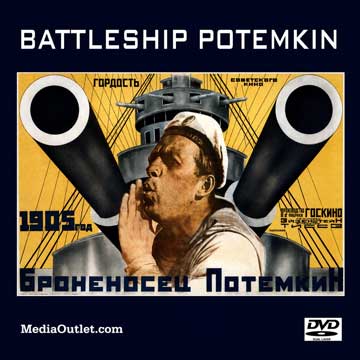
June 27, 1905: The Russian Revolution Of
1905 (The 1905 Russian Revolution, The First Russian Revolution):
The Russo-Japanese War (Russian: Russko-Yaponskaya Voyna, "The
Russian-Japanese War"; Japanese: Nichiro Senso, "The
Japanese-Russian War"): The Battleship Potemkin Mutiny: --
During the Russo-Japanese War, sailors start a mutiny aboard the
Russian battleship Potemkin (Russian: Kniaz Potyomkin
Tavricheskiy, "Prince Potemkin of Taurida"), a
pre-dreadnought battleship built for the Imperial Russian Navy's
Black Sea Fleet. She became famous when her crew rebelled against
their officers during the 1905 Russian Revolution, which is now
viewed as a first step towards the Russian Revolution of 1917. The
mutiny later formed the basis of Sergei Eisenstein's 1925 silent
film The Battleship Potemkin. During the Russo-Japanese War of
1904-05, many of the Black Sea Fleet's most experienced officers
and enlisted men were transferred to the ships in the Pacific to
replace losses. This left the fleet with primarily raw recruits
and less capable officers. With the news of the disastrous Battle
Of Tsushima in May 1905 morale dropped to an all-time low, and any
minor incident could be enough to spark a major catastrophe.
Taking advantage of the situation, plus the disruption caused by
the ongoing riots and uprisings, the Central Committee of the
Social Democratic Organisation of the Black Sea Fleet, called
"Tsentralka", had started preparations for a
simultaneous mutiny on all of the ships of the fleet, although the
timing had not been decided. On 27 June 1905, Potemkin was at
gunnery practice near Tendra Island off the Ukrainian coast when
many enlisted men refused to eat the borscht made from rotten meat
partially infested with maggots. The uprising was triggered when
Ippolit Giliarovsky, the ship's second in command, allegedly
threatened to shoot crew members for their refusal. He summoned
the ship's marine guards as well as a tarpaulin to protect the
ship's deck from any blood in an attempt to intimidate the crew.
Giliarovsky was killed after he mortally wounded Grigory
Vakulinchuk, one of the mutiny's leaders. The mutineers killed
seven of the Potemkin's eighteen officers, including Captain
Evgeny Golikov, and captured the torpedo boat Ismail (No. 627).
They organized a ship's committee of 25 sailors, led by Afanasi
Matushenko, to run the battleship. The committee decided to head
for Odessa flying a red flag and arrived there later that day at
22:00. A general strike had been called in the city and there was
some rioting as the police tried to quell the strikers. The
following day the mutineers refused to land armed sailors to help
the striking revolutionaries take over the city, preferring
instead to await the arrival of the other battleships of the Black
Sea Fleet. Later that day the mutineers aboard the Potemkin
captured a military transport, Vekha, that had arrived in the
city. The riots continued as much of the port area was destroyed
by fire. On the afternoon of 29 June, Vakulinchuk's funeral turned
into a political demonstration and the army attempted to ambush
the sailors who participated in the funeral. In retaliation, the
ship fired two six-inch shells at the theatre where a high-level
military meeting was scheduled to take place, but missed. The
government issued an order to send two squadrons to Odessa either
to force the Potemkin's crew to give up or sink the battleship.
Potemkin sortied on the morning of 30 June to meet the three
battleships Tri Sviatitelia, Dvenadsat Apostolov, and Georgii
Pobedonosets of the first squadron, but the loyal ships turned
away. The second squadron arrived with the battleships Rostislav
and Sinop later that morning, and Vice Admiral Aleksander Krieger,
acting commander of the Black Sea Fleet, ordered the ships to
proceed to Odessa. Potemkin sortied again and sailed through the
combined squadrons as Krieger failed to order his ships to fire.
Captain Kolands of Dvenadsat Apostolov attempted to ram Potemkin
and then detonate his ship's magazines, but he was thwarted by
members of his crew. Krieger ordered his ships to fall back, but
the crew of Georgii Pobedonosets mutinied and joined Potemkin. The
following morning, loyalist members of Georgii Pobedonosets retook
control of the ship and ran her aground in Odessa harbor. The crew
of Potemkin, together with Ismail, decided to sail for Constanta
later that day where they could restock food, water and coal. The
Romanians refused to provide the supplies, backed by the presence
of their small protected cruiser Elisabeta, so the ship's
committee decided to sail for the small, barely defended port of
Theodosia in the Crimea where they hoped to resupply. The ship
arrived on the morning of 5 July, but the city's governor refused
to give them anything other than food. The mutineers attempted to
seize several barges of coal the following morning, but the port's
garrison ambushed them and killed or captured 22 of the 30 sailors
involved. They decided to return to Constanta that afternoon.
Potemkin reached its destination at 23:00 on 7 July and the
Romanians agreed to give asylum to the crew if they would disarm
themselves and surrender the battleship. Ismail's crew decided the
following morning to return to Sevastopol and turn themselves in,
but Potemkin's crew voted to accept the terms. Captain Negru,
commander of the port, came aboard at noon and hoisted the
Romanian flag and then allowed the ship to enter the inner harbor.
Before the crew disembarked, Matushenko ordered that the
Potemkin's Kingston valves be opened so she would sink to the
bottom. When Rear Admiral Pisarevsky reached Constan?a on the
morning of 9 July, he found the Potemkin half sunk in the harbor
and flying the Romanian flag. After several hours of negotiations
with the Romanian Government, the battleship was handed over to
the Russians. Later that day the Russian Navy Ensign was raised
over the battleship. She was then easily refloated by the Russian
navy. #BattleshipPotemkinMutiny #BattleshipPotemkin
#BronenosetsPotyomkin #BattleshipPotyomkin
#KniazPotyomkinTavricheskiy #Mutinies #ImperialRussianNavy #IRN
#BlackSeaFleet #RussianEmpire #The1905RussianRevolution
#RussianRevolutionOf1905 #FirstRussianRevolution #RussoJapaneseWar
#BattleOfTsushima #SergeiEisenstein #Russia #RussianHistory
#HistoryOfRussia #MP4 #VideoDownload #DVD On Sale @ 15% Off
Discount Till Midnight PT!
https://store.earthstation1.com/battleship-potemkin-dual-layer-dvd-aka-bronenosets-potyomkin.html
Today's
EarthStation1.com 15% Off Commemorative Memorial Title: The
Idolmaker (1980) DVD, MP4 Video Download, USB Flash Drive
Today, June 28, 2026
June 27, 1925: #BOTD: #HBD! Doc Pomus,
American blues singer and songwriter best known as the lyricist of
many rock and roll hits who was inducted into The Rock And Roll
Hall Of Fame as a non-performer (1992), the Songwriters Hall of
Fame (1992), and the Blues Hall of Fame (d. March 14, 1991) is
#born Jerome Solon Felder in Williamsburg, Brooklyn into a Jewish
immigrant family. Felder became a fan of the blues after hearing a
Big Joe Turner record. Having had polio as a boy, he walked with
the help of crutches. Later, due to post-polio syndrome,
exacerbated by an accident, Felder eventually relied on a
wheelchair. Using the stage name "Doc Pomus", teenager
Felder began performing as a blues singer. His stage name was not
inspired by anyone in particular; he just thought it sounded
better for a blues singer than the name Jerry Felder. Pomus stated
that more often than not, he was the only Caucasian in the clubs,
but that as a Jew and a polio victim, he felt a special "underdog"
kinship with African Americans, while in turn the audiences both
respected his courage and were impressed with his talent. Gigging
at various clubs in and around New York City, Pomus often
performed with the likes of Milt Jackson, Mickey Baker and King
Curtis. Pomus recorded approximately 40 sides as a singer in the
'40s and '50s for record companies such as Chess, Apollo, Gotham
and others. In the early 1950s, Pomus started writing magazine
articles as well as songwriting for artists such as Lavern Baker,
Ruth Brown, Ray Charles and Big Joe Turner to earn more money to
support a family, after he had married Willi Burke, a Broadway
actress. His first big songwriting break came when the Coasters
had a hit with his song "Young Blood", though the tune
had been radically rewritten by Jerry Leiber and Mike Stoller.
Still, Pomus had co-credit as author, and he soon received a
royalty check for 2,500 USD (22,758 USD in 2019), which convinced
him that songwriting was a career direction worth pursuing. By
1957, Pomus had given up performing for full-time songwriting. He
collaborated with pianist Mort Shuman, whom he met when Shuman was
dating Pomus's younger cousin, to write for Hill & Range Music
Co./Rumbalero Music at its offices in New York City's Brill
Building. Pomus asked Shuman to write with him because Pomus
didn't then know much about rock and roll, whereas Shuman was
familiar with many popular artists of the day. Their songwriting
efforts had Pomus write the lyrics and Shuman the melody, although
often they worked on both. They wrote the hit songs "A
Teenager in Love", "Save The Last Dance For Me",
"Hushabye", "This Magic Moment", "Turn Me
Loose", "Sweets For My Sweet" (a hit for The
Drifters and then The Searchers), "Go, Jimmy, Go",
"Little Sister", "Can't Get Used to Losing You",
"Suspicion", "Surrender" and "(Marie's
the Name) His Latest Flame". During the late 1950s and early
1960s, Pomus wrote several songs with Phil Spector ("Young
Boy Blues"; "Ecstasy"; "What Am I To Do?"),
Mike Stoller and Jerry Leiber ("Young Blood" and "She's
Not You"), and other Brill Building-era writers. Pomus also
wrote "Lonely Avenue", a 1956 hit for Ray Charles. In
the 1970s and 1980s, in his eleventh-floor, two-room apartment at
the Westover Hotel at 253 West 72nd Street, Pomus wrote songs with
Dr. John, Ken Hirsch and Willy DeVille for what he said were
"...those people stumbling around in the night out there,
uncertain or not always so certain of exactly where they fit in
and where they were headed." These later songs ("There
Must Be A Better World", "There Is Always One More
Time", "That World Outside", "You Just Keep
Holding On", and "Something Beautiful Dying" in
particular)-recorded by Willy DeVille, B.B. King, Irma Thomas,
Marianne Faithfull, Charlie Rich, Ruth Brown, Dr. John, James
Booker, and Johnny Adams-are considered by some, including writer
Peter Guralnick, musician and songwriter Dr. John, and producer
Joel Dorn, to be signatures of his best craft. The documentary
film A.K.A. Doc Pomus (2012), conceived by Pomus' daughter Sharyn
Felder, directed by filmmaker Peter Miller, edited by Amy Linton
and produced by Felder, Hechter and Miller, details Pomus' life.
Pomus died on March 14, 1991 from lung cancer, at the age of 65 at
NYU medical center in Manhattan. He is buried at Beth David
Cemetery in Elmont, New York. On June 25, 2019, The New York Times
Magazine listed Doc Pomus among hundreds of artists whose material
was reportedly destroyed in the 2008 Universal fire. The 1980 film
"The Idolmaker" is in large part based on the career of
teen idol Fabian Forte, who became famous as the singer of Doc
Pomus' song "Turn Me Loose". #DocPomus #Songwriters #RNB
#RockNRoll #RockAndRoll #BrillBuilding #MP4 #VideoDownload #DVD On
Sale @ 15% Off Discount Till Midnight PT!
https://store.earthstation1.com/the-idolmaker-bob-marcucci-biography-dvd.html
Today's
EarthStation1.com 15% Off Commemorative Memorial Title: Captain
Kangaroo Starring Bob Keeshan TV Kid Shows DVD, MP4, USB Drive
Today, June 28, 2026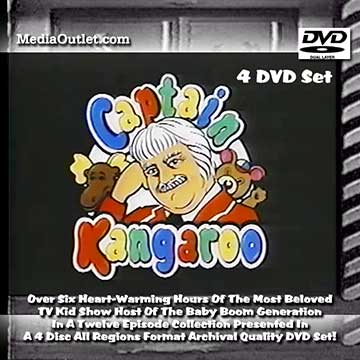
( #JCKaelin here: My parents were friends
of friends of Bob Keeshan while they were living in New Hampshire
and he was living in Vermont, and had the good fortune to have
spent time with him and dinner with him while my parents lived
there. They reported that he was as gracious as everyone who's
ever dealt with him likewise attest :) ) ========= June 27, 1927:
#BOTD: #HBD! Bob Keeshan, American television personality,
producer, author and TV kid show host (d. January 23, 2004) is
#born Robert James Keeshan in Lynbrook, New York. Robert James
"Bob" Keeshan created and played the title role in the
children' television program Captain Kangaroo, which ran from 1955
to 1984, the longest-running nationally broadcast children'
television program of its day. Keeshan also played the original
Clarabell the Clown on the Howdy Doody television program. After
an early graduation from Forest Hills High School in Queens, New
York, in 1945, during World War II, he enlisted in the United
States Marine Corps Reserve, but was still in the United States
when Japan surrendered. He attended Fordham University on the GI
Bill. Network television programs began shortly after the end of
the war. Howdy Doody, an early show which premiered in 1947 on
NBC, was one of the first. Debuting on January 3, 1948, Keeshan
played Clarabell the Clown, a silent Auguste clown who
communicated by honking several horns attached to a belt around
his waist. One horn meant "yes"; two meant "no".
Clarabell often sprayed Buffalo Bob Smith with a seltzer bottle
and played practical jokes. Keeshan gave up the role in 1952, and
was replaced. By September 21, 1953, Keeshan came back to local TV
on WABC-TV, Channel 7 in New York City, in a new children's show,
Time for Fun. He played Corny the Clown, and this time he spoke.
Later that same year, in addition to Time for Fun, Keeshan began
Tinker's Workshop, a program aimed at preschoolers, with him
playing the grandfather-like Tinker. Developing ideas from
Tinker's Workshop, Keeshan and his long-time friend Jack Miller
submitted the concept of Captain Kangaroo to the CBS network,
which was looking for innovative approaches to children's
television programming. CBS approved the show, and Keeshan starred
as the title character when it premiered on CBS on October 3,
1955. Keeshan described his character as based on "the warm
relationship between grandparents and children." The show was
an immediate success, and he served as its host for nearly three
decades. Recurring characters included his sidekick (and fan
favorite) Mr. Green Jeans (played by Hugh "Lumpy"
Brannum), Dennis (played by Cosmo Allegretti), and puppets such as
Bunny Rabbit and Mr. Moose, the pantomime Dancing Bear, and the
stylized longcase clock character Grandfather Clock. The New York
Times commented: "Captain Kangaroo, a round-faced, pleasant,
mustachioed man possessed of an unshakable calm ... was one of the
most enduring characters television ever produced." Keeshan
also had a Saturday morning show called Mister Mayor during the
1964-65 season. Keeshan, in his role as the central character in
both Captain Kangaroo and Mister Mayor, heavily promoted the
products of the Schwinn Bicycle Co., a sponsor, directly on-air to
his audience. By 1972, Keeshan had introduced another character on
Captain Kangaroo to recommend Schwinn products, Mr. Schwinn
Dealer, due to the Federal Trade Commission ruling against
children's show hosts directly endorsing their sponsor's products
during their programs after 1969. Keeshan had a longtime close
friendship with Fred Rogers of Mister Rogers' Neighborhood. Each
paid visits to the other's show (Keeshan on Mister Rogers'
Neighborhood and Rogers on Captain Kangaroo) in 1970, and the two
appeared together on the PBS special Springtime with Mister Rogers
in 1980. The following year, Fred Rogers appeared briefly in
Keeshan's TV special Good Evening, Captain (following Keeshan's
1981 heart attack), in which Rogers and Dick Clark both presented
Keeshan with flowers at the end of the show. Keeshan suffered a
severe heart attack just moments after stepping off a plane at
Toronto Pearson International Airport on July 11, 1981, which
pushed the start of a revamped version of his show back to at
least mid-August. He had come to the city to accept a children's
service award. Keeshan underwent triple-bypass surgery and
received an estimated 5,000 get-well wishes from fans during his
hospitalization. Following the heart attack, Keeshan received
three Emmy awards for Outstanding Performer in 1982, 1983, and
1984. Despite these accolades, Keeshan's show was shortened from
its hour-long format to 30 minutes in 1981, to make room for the
expansion of the CBS Morning News lineup. The program was retitled
Wake Up with the Captain, and moved to a new 7:00 am time slot. At
the start of 1982, the show was rescheduled to an even earlier
slot of 6:30 am. In the fall of 1982, CBS installed it as a
weekend-only hour offering, and two years later, in the fall of
1984, the show became a Saturday half-hour entry. Tired of CBS's
constant reductions of his show, Keeshan left Captain Kangaroo
when his contract with the network ended in December 1984, just
nine months shy of the show's 30th anniversary. By 1987, repeats
of the show were airing daily on many PBS stations. Keeshan's show
was given a farewell of sorts with Captain Kangaroo and Friends, a
primetime network TV special that aired in 1985. After Captain
Kangaroo ended, Keeshan hosted 1985's CBS Storybreak, which
featured animated versions of children's literature. Keeshan
appeared in framing sequences for the animated stories, showcasing
the book versions and suggesting similar books for the viewers to
seek out. In 1987, Keeshan founded Corporate Family Solutions with
former Tennessee Republican Governor Lamar Alexander. The company
provided day-care programs to businesses. Keeshan lived on Melbury
Road in Babylon Village, Long Island, New York, before moving to
spend the last 14 years of his life in Norwich, Vermont, where he
became a children's advocate, as well as an author. He published
his memoirs, entitled Good Morning, Captain, in 1995 by Fairview
Press. He was a strong advocate against video game violence and
took part in congressional hearings in 1993. In addition, he
joined with parents' groups in the 1980s who protested children's
TV shows based on toys like He-Man and Transformers; he felt that
toys turned into TV shows did not teach children anything about
the real world. He also made a rare film appearance in The
Stupids, a 1996 adventure comedy film starring Tom Arnold and
directed by John Landis. Keeshan was an adopted member of the
Dartmouth College class of 1942, receiving an honorary doctorate
from the college in 1975. He was also awarded an honorary doctor
of humane letters by Fordham University in 1975. Le Moyne College,
a Jesuit liberal arts college in Syracuse, New York, awarded him
an honorary doctor of humane letters in 1983. He was awarded an
honorary doctorate by the College of New Rochelle in 1985, after
serving for several years on its board of trustees. In 1997, he
received an honorary doctorate from Middlebury College, the alma
mater of his grandson Britton Keeshan, for his work in children's
literacy. That same year he starred as the Wizard in the St. Louis
Muny Outdoor Theater production of The Wizard Of Oz. In the 1990s,
Keeshan expressed an interest in bringing back a new version of
Captain Kangaroo as a gentler and kinder answer to the violent
cartoons on children's television. Despite having sponsors and
television stations lined up, Keeshan was unable to obtain
permission from ICM, the company that owned the rights to Captain
Kangaroo at that time. Keeshan died in Windsor, Vermont, on
January 23, 2004, at age 76. He was survived by three children:
Michael Derek, Laurie Margaret, and Maeve Jeanne. His wife of 45
years, Anne Jeanne Laurie Keeshan, died February 25, 1996.
Keeshan's grandson, Britton Keeshan, became the youngest person at
that time to have climbed the Seven Summits by climbing Mount
Everest in May 2004. He carried photographs of his grandfather on
that ascent, and buried a photo of the two of them at the summit.
Keeshan was buried in Saint Joseph's Cemetery in Babylon, New
York. #BobKeeshan #TVPersonalities #TVProducers #TVKidShowHosts
#CaptainKangaroo #ClarabellTheClown #HowdyDoody #AugusteClowns
#CornyTheClown #TimeForFun #TinkersWorkshop #HughBrannum
#CosmoAllegretti #DancingBear #BunnyRabbit #GrandfatherClock
#MrMoose #MrGreenJeans #MisterMayor #MrSchwinnDealer
#SchwinnBicycles #SchwinnBicycleCompany #WakeUpWithTheCaptain
#CaptainKangarooAndFriends #CBSStorybreak #GoodMorningCaptain
#CorporateFamilySolutions #TheStupids #TheWizardOfOz
#BabylonVillage #LongIsland #NorwichCT #NBCTV #WABCTV #CBSTV
#TVKidShows #TV #Television #TVShows #TelevisionShows #TVInTheUS
#TelevisionInTheUS #GoldenAgeOfTelevision #ChildrensTelevision
#ChildrensTV #ChildrensTVShows #ClassicTV #ClassicTelevision
#SevenSummits #MountEverest #MtEverest #SaintJosephsCemetery #MP4
#VideoDownload #DVD On Sale @ 15% Off Discount Till Midnight PT!
https://store.earthstation1.com/captain-kangaroo-tv-show-bob-keeshan-dvd.html
Today's
EarthStation1.com 15% Off Commemorative Memorial Title: Offshore
Pirate Radio 1960s-1980s MP3s DVD, Audio Download, USB Drive
Today, June 28, 2026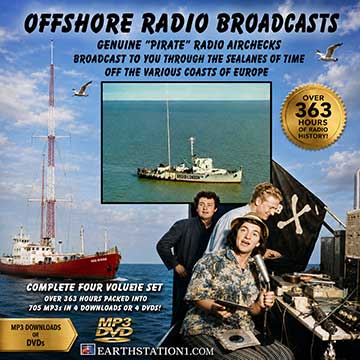
June 27, 1947: #BOTD: #HBD! Jim Fuller,
known as The Godfather Of Surf Music, lead guitarist and main
songwriter for the 1960s Californian surf rock instrumental band
The Surfaris, whose hit single "Wipe Out" made it one of
the best-known instrumental songs of the period (d. March 3, 2017)
is #born James Evans Fuller was also a studio musician, and
performed on many other artists' such as "The Seeds",
rock, folk, and blues songs throughout his career, performing
vocals, lead and bass guitar. Fuller, with his Fender Stratocaster
guitar in photographs and its sound on The Surfaris albums,
contributed to the popularity of Leo Fender's instruments. He is
featured on "Hollywood's Rock Walk of Fame". Along with
the rest of the Surfaris, Fuller was inducted into the Musicians
Hall of Fame in 2019. Jim Fuller died in Arcadia, California, at
the age of 69. His burial details are not publicly disclosed. On
Sale @ 15% Off Discount Till Midnight PT!
https://store.earthstation1.com/offshore-pirate-radio-2-dual-layer-mp3-dvds-uk-amp-euro23.html
Today's
EarthStation1.com 15% Off Commemorative Memorial Title: Captain
Video & Space Patrol Classic TV Kid Shows DVD, MP4, USB Drive
Today, June 28, 2026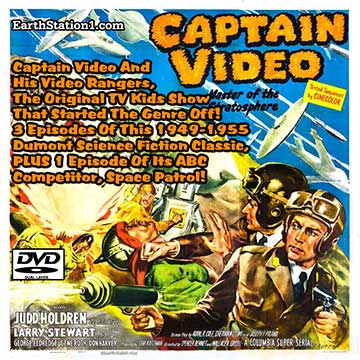
June 27, 1949: Aesthetics: Performing
Arts: Premieres: Television Premieres: United States Television
Premieres: -- Captain Video And His Video Rangers, the iconic
American science fiction television series that was the first
series of its genre on American television, premieres on the
DuMont Television Network. The series aired between June 27, 1949,
and April 1, 1955, originally on Monday through Saturday at 7 p.m.
ET, and then Monday through Friday at 7 p.m. ET. A separate
30-minute spinoff series called The Secret Files of Captain Video
aired Saturday mornings, alternating with Tom Corbett, Space
Cadet, from September 5, 1953, to May 29, 1954, a total of 20
episodes. Researcher Alan Morton estimates there were a total of
1,537 episodes (not counting the 20 Saturday morning episodes),
although few of them exist after the destruction of the original
broadcasts, which was commonplace at that time. Sponsors included
Post Cereals, Skippy Peanut Butter, DuMont-brand television sets,
and Peter Paul's PowerHouse candy bars. Premiums sold via the show
included a flying saucer ring, a "secret seal" ring,
cast photos, electronic goggles, a "secret ray gun", a
rocket ship key chain, decoders, membership cards, and a set of 12
plastic spacemen. Captain Video broadcast its last episode on
April 1, 1955 (April Fool's Day). On Sale @ 15% Off Discount Till
Midnight PT!
https://store.earthstation1.com/captain-video-dvd-and-space-patrol-tv-shows-old-time-television.html
Today's
EarthStation1.com 15% Off Commemorative Memorial Title: Korea: The
Unknown War TV Korean War Series DVD, Download, USB Drive
Today, June 28, 2026
June 27, 1950: Korea: The History Of
Korea: The Aftermath Of World War II: The Cold War: The Cold War
In Asia: The Korean Conflict: The Cold War (1947-1953): The Cold
War In Asia: The Korean War: -- The United States decides to send
troops to fight in the Korean War in support of South Korea. Two
days prior, on June 25, 1950, the Korean War began as North Korean
troops, led by Soviet-built tanks, crossed the 38th parallel and
launched a full scale invasion of South Korea following a series
of clashes along the border. Five days later, U.S. ground forces
entered the conflict. The Korean War was a war between North Korea
(with the support of China and the Soviet Union) and South Korea
(with the principal support of the United States). The United
Nations, with the United States as the principal force, came to
the aid of South Korea. China came to the aid of North Korea, and
the Soviet Union also gave some assistance to the North. As a
product of the Cold War between the Soviet Union and the United
States, Korea was split into two regions with separate
governments. Both claimed to be the legitimate government of all
of Korea, and neither accepted the border as permanent. When the
conflict escalated into open warfare when North Korea invaded
South Korea, the United Nations Security Council authorized the
formation and dispatch of UN forces to Korea to repel what was
recognized as a North Korean invasion. Twenty-one countries of the
United Nations eventually contributed to the UN force, with the
United States providing around 90% of the military personnel.
After the first two months of war, South Korean and U.S. forces
rapidly dispatched to Korea were on the point of defeat, forced
back to a small area in the south known as the Pusan Perimeter. In
September 1950, an amphibious UN counter-offensive was launched at
Incheon, and cut off many North Korean troops. Those who escaped
envelopment and capture were forced back north. UN forces rapidly
approached the Yalu River-the border with China-but in October
1950, mass Chinese forces crossed the Yalu and entered the war.
The Chinese intervention triggered a retreat of UN forces which
continued until mid-1951. After these reversals of fortune, which
saw Seoul change hands four times, the last two years of fighting
became a war of attrition, with the front line close to the 38th
parallel. The war in the air, however, was never a stalemate.
North Korea was subject to a massive bombing campaign. Jet
fighters confronted each other in air-to-air combat for the first
time in history, and Soviet pilots covertly flew in defense of
their communist allies. The fighting ended on 27 July 1953, when
an armistice was signed. The agreement created the Korean
Demilitarized Zone to separate North and South Korea, and allowed
the return of prisoners. However, no peace treaty has been signed
at Panmunjon, and according to some sources the two Koreas are
technically still at war, engaged in a frozen conflict. In April
2018, the leaders of North and South Korea met at the
demilitarized zone and agreed to sign a treaty by the end of the
year to formally end the Korean War. As a war undeclared by all
participants, the conflict helped bring the term "police
action" into common use. It also led to the permanent
alteration of the balance of power within the United Nations,
where Resolution 377-passed in 1950 to allow a bypassing of the
Security Council if that body could not reach an agreement-led to
the General Assembly displacing the Security Council as the
primary organ of the UN. #KoreanWar #KoreanConflict #ColdWars
#KoreanConflict #ColdWars #NorthKorea #SouthKorea #UnitedStates
#US #UnitedNations #UN #PoliceActions #ColdWar #MP4 #VideoDownload
#DVD On Sale @ 15% Off Discount Till Midnight PT!
https://store.earthstation1.com/korea-the-unknown-war-dvd-complete-6-part-tv-series-3-dis63.html
Today's
EarthStation1.com 15% Off Commemorative Memorial Title: Heart Of
The Dragon TV Series DVD, Video Download, USB Flash Drive
Today, June 28, 2026
June 27, 1981: China: The History Of
China: The People's Republic Of China (PRC): The History Of The
People's Republic Of China (The History Of The PRC): Maoism (Mao
Zedong Thought): The Cultural Revolution (CR, The Great
Proletarian Cultural Revolution): The China: The History Of China:
The People's Republic Of China (PRC): The History Of The People's
Republic Of China (The History Of The PRC): Aftermath Of The
Cultural Revolution: The Sixth Plenary Session Of The Eleventh
Central Committee Of The Chinese Communist Party: Resolution On
Certain Questions In The History Of Our Party Since The Founding
Of The People's Republic Of China (Chinese: Guanyu Jianguo Yilai
Dang De Ruogan Lishi Wenti De Jueyi): -- The Sixth Plenum of the
Central Committee Of The Chinese Communist Party unanimously
adopts a resolution blaming for the Cultural Revolution on Mao
Zedong. It is the second of the three major historical resolutions
of The Chinese Community Party (CCP). The first was the 1945
Resolution which unified the party around the ideological
foundation of Mao Zedong Thought. The third historical resolution
came in 2021 which unified the party around the ideological
foundation of Xi Jinping Thought -- the latter being evidence that
that current CCP tragically failed to learn from, and draw the
proper conclusions from, their prior mistakes. The Sixth Plenum of
the CCP's Eleventh Central Committe's second generation party
leaders led by Deng Xiaoping evaluated the situation and
determined it to be a historical turning point. The day prior,
June 26, 1981, The Sixth Plenum of the Central Committee accepted
the resignation of Hua Guofeng as chairman. The Resolution had
been prepared over the course of the preceding 15 months. The
Resolution was revised repeatedly per Deng's views. Many of Deng's
suggestions emphasized the need to affirm Mao's revolutionary
contributions and not only to criticize his errors. Prior to this
formal assessment of the Mao era, the CCP had begun receding from
various of Mao's ideas and policies, particularly after the Third
Plenum in December 1978. The Resolution begins by reviewing the
history of the PRC. It describes Mao as first among equals in the
development of Mao Zedong Thought before 1949 and deeming Mao
Zedong Thought as successful in establishing national
independence, transforming China's social classes, the development
of economic self-sufficiency, the expansion of education and
health care, and China's leadership role in the Third World. The
Resolution describes setbacks during the period 1957 to 1964
(although it generally affirms this period) and major mistakes
beginning in 1965. It attributes Mao's errors to individualist
tendencies which arose when he departed from the collective view
of the leadership and traces these errors to the beginning of the
Great Leap Forward. The Resolution states that Mao's errors are
not solely his fault, but are also attributable to Jiang Qing,
Kang Sheng, and Lin Biao. It describes these others as careerists
who took advantage of, and exacerbated, Mao's errors, leading to
the Cultural Revolution. The Resolution critiqued Mao for
developing a cult of personality in his later years and for
undermining the principles of democratic centralism. The
Resolution repudiates the persecution of intellectuals and the
attacks on the CCP apparatus during the Cultural Revolution and
states that the errors of the Cultural Revolution will be
overturned. Regarding the Cultural Revolution, the Resolution
states, "Chief responsibility for the grave left error of the
Cultural Revolution, an error comprehensive in magnitude and
protracted in duration, does indeed lie with Comrade Mao Zedong."
The Resolution formally rehabilitated Liu Shaoqi and Deng
Xiaoping, among others. The Resolution describes three central
guiding principles that extend from the past to the present: 1)
Seeking Truth From Facts, a historically established idiomatic
expression (chengyu) in the Chinese language that first appeared
in the 111 CE Book Of Han. Originally, it described an attitude
toward study and research; popularized by Mao Zedong, it became a
major slogan of the Chinese Communist Party (CCP) and the
inspiration for its principal theoretical journal, Qiushi. the
leading official theoretical journal and bi-monthly news magazine
of the CCP; 2) The Mass Line, a political, organizational, and
leadership methodology developed by Mao Zedong and the CCP during
the Chinese Communist Revolution, in which leadership formulates
policy based on theory, implements it based on the people's real
world conditions, revises the theory and policy based on actual
practice, and uses that revised theory as the guide to future
practice. This process is summarized as leadership "from the
masses, to the masses", repeated indefinitely; and 3)
National Independence. As the document draws to a close, it
describes the basic issues for the present as the Four
Modernizations, reunification with Taiwan, and identifies the Four
Cardinal Principles of 1) upholding the socialist road, 2)
upholding the people's democratic dictatorship, 3) upholding the
CCP's leadership, and 4) upholding the guidance of Mao Zedong
Thought and Marxism-Leninism. Regarding Mao's legacy, the
Resolution concludes Mao's contributions to the Chinese Revolution
far outweigh his mistakes. Following the Resolution, the idea that
Mao was 70% correct and 30% incorrect became a common description
of his legacy, reflecting Deng's own public statement that
"Chairman Mao was seven parts good, three parts bad".
The Resolution is one of the most influential documents in the
history of the Communist Party of China. By summarizing historical
experiences, it provides both historical and theoretical bases for
establishing the guidelines for China's next phase of development.
Furthermore, it also offers historical and theoretical foundations
for the redistribution of power within the state and the party by
figures such as Deng Xiaoping. The anti-reform faction was
essentially ousted from the upper echelons of the Chinese
Communist Party, leading to the preliminary establishment of the
"Second Generation Central Leadership Of The Communist Party
Of China" with Deng Xiaoping at its core. By striking a
balance between criticizing and preserving the legacy of the
Mao-era, the Resolution helped solidify Deng's leadership. The
Resolution was followed by a three-year campaign to "totally
negate" the Cultural Revolution. The communist party called
on individuals and cooperatives to study the Resolution and engage
in criticism and self-criticism. People were urged to root out
followers of Lin Biao and the Gang of Four, those seriously
impacted by factional ideas, and the "smashers and grabbers"
of the Cultural Revolution. The Resolution's language regarding
the Mao-era is largely echoed by the 2021 Resolution on the Major
Achievements and Historical Experience of the Party over the Past
Century, though fails almost universally to draw the proper
conclusions from those experiences. On Sale @ 15% Off Discount
Till Midnight PT!
https://store.earthstation1.com/heart-of-the-dragon-dvds-post-mao-china-all-12-tv-shows-3-di123.html
Today's
EarthStation1.com #OnThisDay Commemorative Memorial Title: Martin
Mull Presents The History Of White People In America DVD MP4 USB
Today, June 28, 2026 ( #JCKaelin here: About a year before
Martin passed. his daughter bought one of my titles for him and
had it shipped to his home in LA. I added a note thanking him for
his introducing me to a kind of humor I never knew existed, as I
watched him via my black & white Toshiba portable TV on
Ferwood 2 Night and its successor America Tonight. That sense of
humor has stayed with me throughout my life, and I will always be
grateful :) ) ========= June 27, 2024: #DOTD: #RIP: Martin Mull,
American actor, comedian, painter and recording artist who has
appeared in many television and film roles (b. August 18, 1943)
#dies from a long undisclosed illness at his Los Angeles home,
aged 80. His burial details are not publicly disclosed. Martin
Mull was born Martin Eugene Mull in Chicago. As an actor, he first
became known in his role on Mary Hartman, Mary Hartman and its
spin-offs Fernwood 2 Night and America 2 Night. Among his other
notable roles are Eric Swan in FM, Colonel Mustard in the 1985
film Clue, Leon Carp on Roseanne, Willard Kraft on Sabrina, the
Teenage Witch, Vlad Plasmius on Danny Phantom, and Gene Parmesan
on Arrested Development. He also hosted and appeared in the
mockumentaries The History Of White People and Portrait Of A White
Marriage. He had a recurring role on Two and a Half Men as
Russell, the drug-using, humorous pharmacist, and as Jim Kringle
on Reno 911. #MartinMull #Actors #TVActors #MovieActors #Comedians
#Artists #Painters #Guitarists #MaryHartman #Fernwood2Night
#America2Night #FM #Clue #Roseanne #SabrinaTheTeenageWitch
#TheHistoryOfWhitePeopleInAmerica #HistoryOfWhitePeopleInAmerica
#HistoryOfWhitePeople #TheHistoryOfWhitePeople
#PortraitOfAWhiteMarriage #Reno911 #TVHosts #TelevisionHosts #TV
#Television #TVShows #TelevisionShows #TVInTheUS
#TelevisionInTheUS #Movies #Film #MotionPictures #Hollywood
#AmericanCinema #CinemaOfTheUS #MP4 #VideoDownload #DVD
https://store.earthstation1.com/martin-mull-presents-the-history-of-white-people-in-america-dvd.html
( #JCKaelin here: About a year before
Martin passed. his daughter bought one of my titles for him and
had it shipped to his home in LA. I added a note thanking him for
his introducing me to a kind of humor I never knew existed, as I
watched him via my black & white Toshiba portable TV on
Ferwood 2 Night and its successor America Tonight. That sense of
humor has stayed with me throughout my life, and I will always be
grateful :) ) ========= June 27, 2024: #DOTD: #RIP: Martin Mull,
American actor, comedian, painter and recording artist who has
appeared in many television and film roles (b. August 18, 1943)
#dies from a long undisclosed illness at his Los Angeles home,
aged 80. His burial details are not publicly disclosed. Martin
Mull was born Martin Eugene Mull in Chicago. As an actor, he first
became known in his role on Mary Hartman, Mary Hartman and its
spin-offs Fernwood 2 Night and America 2 Night. Among his other
notable roles are Eric Swan in FM, Colonel Mustard in the 1985
film Clue, Leon Carp on Roseanne, Willard Kraft on Sabrina, the
Teenage Witch, Vlad Plasmius on Danny Phantom, and Gene Parmesan
on Arrested Development. He also hosted and appeared in the
mockumentaries The History Of White People and Portrait Of A White
Marriage. He had a recurring role on Two and a Half Men as
Russell, the drug-using, humorous pharmacist, and as Jim Kringle
on Reno 911. #MartinMull #Actors #TVActors #MovieActors #Comedians
#Artists #Painters #Guitarists #MaryHartman #Fernwood2Night
#America2Night #FM #Clue #Roseanne #SabrinaTheTeenageWitch
#TheHistoryOfWhitePeopleInAmerica #HistoryOfWhitePeopleInAmerica
#HistoryOfWhitePeople #TheHistoryOfWhitePeople
#PortraitOfAWhiteMarriage #Reno911 #TVHosts #TelevisionHosts #TV
#Television #TVShows #TelevisionShows #TVInTheUS
#TelevisionInTheUS #Movies #Film #MotionPictures #Hollywood
#AmericanCinema #CinemaOfTheUS #MP4 #VideoDownload #DVD
https://store.earthstation1.com/martin-mull-presents-the-history-of-white-people-in-america-dvd.html
Today's
EarthStation1.com #OnThisDay Commemorative Memorial Title: Classic
Marital Guidance & Marriage Counseling Films DVD Download USB
Today, June 28, 2026June 27: Decide To Be Married Day: --
This day could be your time, so get ready to pop the question!
Whether you're planning a massive flash mob or a sweet
proclamation of love over dinner, June 27 is the day we honor all
types of proposals! Although there is no information regarding the
history of Decide to Be Married Day, it has always been celebrated
on June 27 every year. Decide to Be Married Day is a day to honor
all those who have just got engaged. Weddings are one of
humanity's most pleasurable festivities, with traditions that
differ by culture. It is, nonetheless, one of the most demanding
occasions to organize. The planning usually takes a toll on both
the bride and groom, bringing them down from the high of the
proposal, especially if no one is present to help. Marriage
engagements were traditionally conducted through the signing of
legal documents or between family meetings for the majority of
history. Oil paintings from the early modern period depict a man
and a woman standing next to each other during their engagement.
Nowadays, with technology around us, we can capture the whole
moment. That is why, kneeling, or, if you're feeling fancy,
'genuflecting' (the act of getting down on one knee in front of
something sacred) is thus a relatively new ritual. Kneeling was a
convenient technique to portray the act of proposing in silent
films of the 1920s, first noted in artwork in the daily penny
newspaper of the 1800s. Kneeling became the de facto way of
proposing around the world as a result of its image in modern pop
culture. Getting married also used to be a man's decision because
he was the only one who could propose, but nowadays, the majority
of couples make this decision together. So, whether you're halfway
through your to-do list, trying to propose to your partner, or
simply trying to figure it out, Decide to Be Married Day has a lot
to offer.
https://store.earthstation1.com/classic-marital-guidance-marriage-counseling-films-dvd.html
Today's
EarthStation1.com #OnThisDay Commemorative Memorial Title: One Of
Our Aircraft Is Missing 1942 WWII Film DVD, Download, USB Drive
Today, June 28, 2026June 27, 1942: Aesthetics: Performing
Arts: Premieres: Film Premieres: British Film Premieres: -- One Of
Our Aircraft Is Missing (stylized onscreen as "......one of
our aircraft is missing") is released to theaters. One Of Our
Aircraft Is Missing is a British black-and-white war film, mainly
set in the German-occupied Netherlands. It was the fourth
collaboration between the British writer-director-producer team of
Michael Powell and Emeric Pressburger and the first film they made
under the banner of The Archers. Although considered a wartime
propaganda film and made under the authority of the Ministry of
Information as part of a series of film productions specifically
aimed at morale in the United Kingdom, it is elevated by the story
and production values above the usual jingoistic fare. Today, One
of Our Aircraft Is Missing is considered one of the "best of
British films of the era". A reversal of the plot of Powell
and Pressburger's previous film, 49th Parallel (1941), One of Our
Aircraft Is Missing has the British trying to escape with the help
of various locals. In the 49th Parallel, the Germans stranded in
Canada argued and fought amongst themselves, while the British
fliers in this film work well together as a team.
https://store.earthstation1.com/one-of-our-aircraft-is-missing-dual-layer-dvd-remastered-wwii-film.html
Today's
EarthStation1.com #OnThisDay Commemorative Memorial Title: Mo'
Funny: Black Comedy In America DVD Video Download
Today, June 28, 2026June 27, 1872: #BOTD: #HBD! Paul Laurence
Dunbar, African American poet, novelist, and short story writer of
the late 19th and early 20th centuries (d. February 9, 1906) is
#born at 311 Howard Street in Dayton, Ohio to parents who were
enslaved in Kentucky before the American Civil War. Dunbar began
writing stories and verse when he was a child. He published his
first poems at the age of 16 in a Dayton newspaper, and served as
president of his high school's literary society. Dunbar's
popularity increased rapidly after his work was praised by William
Dean Howells, a leading editor associated with Harper's Weekly.
Dunbar became one of the first African American writers to
establish an international reputation. In addition to his poems,
short stories, and novels, he also wrote the lyrics for the
musical comedy In Dahomey (1903), the first all-African American
musical produced on Broadway in New York. The musical later toured
in the United States and the United Kingdom. Suffering from
tuberculosis, which then had no cure, Dunbar died in Dayton, Ohio,
at the age of 33. Much of Dunbar's more popular work in his
lifetime was written in the "Negro dialect" associated
with the antebellum South, though he also used the Midwestern
regional dialect of James Whitcomb Riley. Dunbar also wrote in
conventional English in other poetry and novels and is considered
the first important African American sonnet writer. Since the late
20th century, scholars have become more interested in these other
works. Paul Laurence Dunbar died of tuberculosis in Dayton, Ohio
at the age of 33. He is interred in the Woodland Cemetery in
Dayton.
https://store.earthstation1.com/mo39-funny-black-comedy-in-america-dvd-video-downlo39.html
Today's
EarthStation1.com #OnThisDay Commemorative Memorial Title: The
Rolling Stones Early Live In London 1963-1965 MP3 CD Download
Today, June 28, 2026June 27, 2014: #DOTD: #RIP: Bobby Womack,
African American singer, songwriter, musician, and record producer
(b. March 4, 1944) #dies at his home in Tarzana, California at the
age of 70. He was cremated, and his ashes were inurned at the
Forest Lawn Memorial Park Cemetery in Glendale, California, in The
Great Mausoleum, Memorial Terrace, Memorial Terrace Columbarium.
Bobby Womack was born Robert Dwayne Womack in Cleveland, Ohio's
Fairfax neighborhood. Starting in the early 1950s as the lead
singer of his family musical group the Valentinos and as Sam
Cooke's backing guitarist, Womack's career spanned more than 60
years and multiple styles, including R & B, soul, rock and
roll, doo-wop, and gospel. Womack was a prolific songwriter who
wrote and originally recorded, (with his brothers, the
Valentinos), the Rolling Stones' first UK number one hit, "It's
All Over Now" and New Birth's "I Can Understand It".
As a singer, he is most notable for the hits "Lookin' for a
Love", "That's the Way I Feel About Cha", "Woman's
Gotta Have It", "Harry Hippie", "Across 110th
Street", and his 1980s hits "If You Think You're Lonely
Now" and "I Wish He Didn't Trust Me So Much". In
2009, Womack was inducted into The Rock And Roll Hall Of Fame.
https://store.earthstation1.com/the-rolling-stones-early-live-in-london-196319196319653.html
Today's
EarthStation1.com #OnThisDay Commemorative Memorial Title: Tommy:
The Who In Concert 1989 DVD, Video Download, USB Flash Drive
Today, June 28, 2026June 27, 2002: #DOTD: #RIP: John
Entwistle, English singer, songwriter, film and music producer,
and Freemason, best known as the original bass guitarist of The
Who from the band's formation until his death (b. October 9, 1944)
#dies in Room 658 at the Hard Rock Hotel and Casino in Paradise,
Nevada, one day before the scheduled first show of the Who's 2002
United States tour. He was 57 years old. Entwistle had gone to bed
that night with Alycen Rowse, a local stripper and groupie, who
awoke the next morning to find Entwistle cold and unresponsive.
The Clark County medical examiner determined that his death was
due to a heart attack induced by an undetermined amount of
cocaine. Entwistle already had severe heart disease and usually
smoked 20 cigarettes a day. Entwistle had undergone a medical
examination for insurance purposes before the Who's 2002 tour
started. The exam revealed high blood pressure and high
cholesterol. Entwistle's authorized biographer Paul Rees has
suggested that a more detailed physical examination would have
revealed that three of his arteries were blocked and necessitated
surgery. His funeral was held at St Edward's Church in
Stow-on-the-Wold, Gloucestershire, England, on July 10, 2002. His
body was cremated and his ashes were buried privately on the
grounds of his mansion, Quarwood. A memorial service was held on
October 24 at St Martin-in-the-Fields, Trafalgar Square, London.
Entwistle's huge collection of guitars and basses was auctioned at
Sotheby's in London by his son, Christopher, to meet anticipated
taxes on his father's estate. On Pete Townshend's website,
Townshend and Roger Daltrey published a tribute, saying, "The
Ox has left the building - we've lost another great friend. Thanks
for your support and love. Pete and Roger." Entwistle's
mansion, Quarwood, and some of his personal effects were later
sold off to meet the demands of the Inland Revenue, a department
of the British Government responsible for the collection of direct
taxation; he had worked for the agency from 1962 to 1963 as a tax
officer before being demoted to filing clerk, prior to joining the
Who. One aspect of Entwistle's life which emerged after his death
came as a surprise even to those closest to him, including the
members of the Who. "It wasn't until the day of his funeral
that I discovered that he'd spent most of his life as a
Freemason", said Pete Townshend. John Entwistle was born John
Alec Entwistle in Chiswick, which is now part of London, England.
His music career that spanned more than 40 years. He was the only
member of the band to have formal musical training. He was
inducted into The Rock And Roll Hall Of Fame as a member of the
Who in 1990. Entwistle's instrumental approach used pentatonic
lead lines, and a then-unusual treble-rich sound ("full
treble, full volume") created by roundwound RotoSound steel
bass strings. He was nicknamed "The Ox" and
"Thunderfingers," the latter because his digits became a
blur across the four-string fretboard. In 2011, he was voted as
the greatest bass guitarist of all time in a Rolling Stone
magazine reader's poll, and in its special "100 Greatest Bass
Players" issue in 2017, Bass Player Magazine named Entwistle
at number seven. Entwistle is considered by many to be the best
rock bass guitarist who ever lived. #JohnEntwistle #Singers
#Songwriters #Producers #TheWho #Bassists #BassPlayers #RockMusic
#BritishRock #ArtRock #HardRock #PowerPop #Mods #ModSubculture
#ClassicRock #MP4 #VideoDownload #DVD
https://store.earthstation1.com/tommy-the-who-in-concert-live-dvd-universal-amphitheater-890824.html
Today's
EarthStation1.com #OnThisDay Commemorative Memorial Title: Richard
Nixon Reflects With Morton Kondracke DVD, Download, USB Drive
Today, June 28, 2026June 27, 1974: The Aftermath Of World War
II: The Cold War: The Cold War: The Cold War (1962-1979): The
Presidency Of Richard Nixon: Detente (French, "Relaxation"):
The Moscow Summit (1972) (The Moscow Summit Of 1972): -- Richard
Nixon, the first U.S. president to visit the Soviet Union, arrives
in Moscow to a welcome ceremony, cheering crowds, and a state
dinner at the Grand Kremlin Palace that evening for his second
USSR visit, in order to attend the Moscow Summit meeting that
began the following day, June 28, which summit lasted until July
3, 1974. The Moscow Summit Of 1974 was a summit meeting between
President Richard M. Nixon of the United States and General
Secretary Leonid Brezhnev of the Communist Party of the Soviet
Union. It featured the signing of the Threshold Test Ban Treaty
(TTBT). The summit followed the Washington Summit the previous
year as well as considerable progress in U.S.-Soviet relations
made by Nixon in the previous two years. Nixon and Brezhnev met in
Yalta, where they discussed a proposed mutual defense pact,
detente, and MIRVs. Nixon considered proposing a comprehensive
test-ban treaty, but he felt he would not have time to complete it
during his presidency. There were no significant breakthroughs in
these negotiations. The visit was the final one of Nixon's
presidency as he would give his resignation speech in August of
that year. #RichardNixon #POTUS #POTUSHistory #LeonidBrezhnev
#Detente #ColdWar #TriangularDiplomacy #UnitedStates #US
#SovietUnion #USSR #NuclearWeapons #ArmsControl
#NuclearDisarmament #AmericanHistory #USHistory #HistoryOfTheUS
#WesternCulture #WesternCivilization #OccidentalCulture
#WesternWorld #WesternSociety #WesternTradition
#StoryOfCivilization #SovietHistory #HistoryOfTheSovietUnion #MP4
#VideoDownload #DVD
https://store.earthstation1.com/richard-nixon-reflects-dvd-morton-kondracke-interview.html
Today's
EarthStation1.com #OnThisDay Commemorative Memorial Title: Outer
Space Films 7 The Space Shuttle DVD, MP4 Download, USB Drive
Today, June 28, 2026June 27, 1982: Rocket Launches: The
History Of Rocketry: The History Of Spaceflight: The Aftermath Of
World War II: The Cold War: The Space Age: The Space Race: Space
Programs Of The United States: Human Spaceflight Programs: The
Space Shuttle Program (The Space Transportation System (STS)):
STS-4: -- Space Shuttle Columbia is launched at 15:00:00 UTC from
the Kennedy Space Center's Kennedy Space Center's Launch Complex
39A (LC-39A) on the final research and development flight mission.
STS-4 was the fourth NASA Space Shuttle mission, and also the
fourth mission for Space Shuttle Columbia. The mission landed a
week later on American Independence Day, The 4th of July. STS-4
was the final test flight for the shuttle; it was thereafter
officially declared to be operational. Columbia carried numerous
scientific payloads during the mission, as well as military
missile detection systems.
https://store.earthstation1.com/outer-space-films-7-the-space-shuttle-dv7.html
Today's
EarthStation1.com #OnThisDay Commemorative Memorial Title: Z
(1969) Grigoris Lambrakis & The Greek Generals Coup Of 1967
MP4 DVD
Today, June 28, 2026June 27, 1999: #DOTD: Georgios
Papadopoulos, Greek colonel and politician, 169th Prime Minister
of Greece, leader of the coup d'etat that established a military
regime known as the Greek Military Junta Of 1967-74 that lasted
for seven years, commonly known as the Regime of the Colonels, or
in Greece simply The Junta (b. May 5, 1919) #dies aged 80.
Papadopoulos showed no remorse for his actions and steadfastly
refused to apply for parole or amnesty or to use the leniency
provisions that allowed him to be released on the grounds of ill
health, as did several of his associates, such as Makarezos and
Zoitakis. In the summer of 1996, his health deteriorated and he
was diagnosed with ALS and bladder cancer, resulting in his being
hospitalized for three years in an Athens hospital until his death
on June 27, 1999. He was buried in First Cemetery of Athens three
days later, in the presence of old associates and regime
sympathisers. Georgios Papadopoulos was born in Elaiohori, a small
village in the Prefecture of Achaea in the Peloponnese, Kingdom Of
Greece. On April 21, 1967, a few days before the general election
in Greece, Colonel George Papadopoulos leads a coup d'etat,
establishing a military regime known as the Greek Military Junta
Of 1967-74 that lasted for seven years. Commonly known as the
Regime of the Colonels, or in Greece simply The Junta, The
Dictatorship and The Seven Years, The Greek Military Junta Of
1967-1974 was a series of far-right military juntas that ruled
Greece following the 1967 Greek coup d'etat led by a group of
colonels on 21 April 1967. The dictatorship ended on 24 July 1974
under the pressure of the Turkish invasion of Cyprus. The fall of
the junta was followed by the Metapolitefsi (the transitional
period from the fall of the dictatorship to the 1974 legislative
elections and the democratic period immediately after these
elections) and the establishment of the Third Hellenic Republic
(formed after both the fall of Greek military junta and final the
abolition of the Greek monarchy), which rules up to the present
day. #GreekCoup #GreekJunta #GreekMilitaryJuntaOf19671974
#RegimeOfTheColonels #TheJunta #TheDictatorship #TheSevenYears
#GeorgePapadopoulos #Coups #CoupsDETat #The7Years #Greece
#ModernGreece #GreekHistory #ModernGreekHistory #MP4
#VideoDownload #DVD
https://store.earthstation1.com/z-1969-dvd-yves-montand-irene-papas-jeanlouis-trintig1969.html
Today's
EarthStation1.com #OnThisDay Commemorative Memorial Title: Z
(1969) Grigoris Lambrakis & The Greek Generals Coup Of 1967
MP4 DVD
Today, June 28, 2026June 27, 1999: #DOTD: Georgios
Papadopoulos, Greek colonel and politician, 169th Prime Minister
of Greece, leader of the coup d'etat that established a military
regime known as the Greek Military Junta Of 1967-74 that lasted
for seven years, commonly known as the Regime of the Colonels, or
in Greece simply The Junta (b. May 5, 1919) #dies aged 80.
Papadopoulos showed no remorse for his actions and steadfastly
refused to apply for parole or amnesty or to use the leniency
provisions that allowed him to be released on the grounds of ill
health, as did several of his associates, such as Makarezos and
Zoitakis. In the summer of 1996, his health deteriorated and he
was diagnosed with ALS and bladder cancer, resulting in his being
hospitalized for three years in an Athens hospital until his death
on June 27, 1999. He was buried in First Cemetery of Athens three
days later, in the presence of old associates and regime
sympathisers. Georgios Papadopoulos was born in Elaiohori, a small
village in the Prefecture of Achaea in the Peloponnese, Kingdom Of
Greece. On April 21, 1967, a few days before the general election
in Greece, Colonel George Papadopoulos leads a coup d'etat,
establishing a military regime known as the Greek Military Junta
Of 1967-74 that lasted for seven years. Commonly known as the
Regime of the Colonels, or in Greece simply The Junta, The
Dictatorship and The Seven Years, The Greek Military Junta Of
1967-1974 was a series of far-right military juntas that ruled
Greece following the 1967 Greek coup d'etat led by a group of
colonels on 21 April 1967. The dictatorship ended on 24 July 1974
under the pressure of the Turkish invasion of Cyprus. The fall of
the junta was followed by the Metapolitefsi (the transitional
period from the fall of the dictatorship to the 1974 legislative
elections and the democratic period immediately after these
elections) and the establishment of the Third Hellenic Republic
(formed after both the fall of Greek military junta and final the
abolition of the Greek monarchy), which rules up to the present
day. #GreekCoup #GreekJunta #GreekMilitaryJuntaOf19671974
#RegimeOfTheColonels #TheJunta #TheDictatorship #TheSevenYears
#GeorgePapadopoulos #Coups #CoupsDETat #The7Years #Greece
#ModernGreece #GreekHistory #ModernGreekHistory #MP4
#VideoDownload #DVD
https://store.earthstation1.com/z-1969-dvd-yves-montand-irene-papas-jeanlouis-trintig1969.html
Today's
EarthStation1.com #OnThisDay Commemorative Memorial Title:
Operation Barbarossa: Nazi Invasion Of Russia + Bonus MP4 Download
DVD
Today, June 28, 2026June 27, 1941: The European Civil War:
World War II: The Second European War (The European Theater Of
World War II): The Eastern Front Of World War II: The Great
Patriotic War (The German-Soviet War): Operation Barbarossa: The
Battle Of Bialystok-Minsk: -- German troops of the Wehrmacht's
Army Group Centre under Field Marshal Fedor Von Bock capture the
city of Bialystok during the penetration of the Soviet border
region in the opening stage of Operation Barbarossa, the invasion
of the Soviet Union by Nazi Germany and many of its Axis allies.
The Battle of Bialystok-Minsk was a German strategic operation
lasting from June 22 to July 9, 1941. The Army Group's 2nd Panzer
Group under Colonel General Heinz Guderian and the 3rd Panzer
Group under Colonel General Hermann Hoth decimated the Soviet
frontier defenses, defeated all Soviet counter-attacks and
encircled four Soviet Armies of the Red Army's Western Front near
Bialystok and Minsk by June 30. The majority of the Western Front
was enclosed within, and the pockets were liquidated by July 9.
The Red Army losses were a staggering 420,000 or 474,000 men,
while Wehrmacht casualties were over 12,157. The Germans destroyed
the Soviet Western Front in 18 days and advanced 460 kilometers
into the Soviet Union, causing many to believe that the Germans
had effectively already won the war against the Soviet Union. Five
days prior, on June 22, 1941 starting at 3:15 am, some 3.2 million
German soldiers plunged headlong into Russia across an 1800-mile
front, in a major turing point of World War II. At 7 am that
morning, a proclamation from Hitler to the German people
announced, "At this moment a march is taking place that, for
its extent, compares with the greatest the world has ever
seen...". Operation Barbarossa (German: Unternehmen
Barbarossa) stemmed from Nazi Germany's ideological aims to
conquer the western Soviet Union so that it could be repopulated
by Germans, to use Slavs, especially Poles, as a slave-labour
force for the Axis war effort, and to seize the oil reserves of
the Caucasus and the agricultural resources of Soviet territories.
In the two years leading up to the invasion, Germany and the
Soviet Union signed political and economic pacts for strategic
purposes. Nevertheless, the German High Command began planning an
invasion of the Soviet Union in July 1940 (under the codename
Operation Otto), which Adolf Hitler authorized on 18 December
1940. Over the course of the operation, about four million Axis
powers personnel, the largest invasion force in the history of
warfare, invaded the western Soviet Union along a 2,900-kilometer
(1,800 mi) front. In addition to troops, the Wehrmacht employed
some 600,000 motor vehicles, and between 600,000 and 700,000
horses for non-combat operations. The offensive marked an
escalation of the war, both geographically and in the formation of
the Allied coalition. Operationally, German forces achieved major
victories and occupied some of the most important economic areas
of the Soviet Union, mainly in the Ukrainian Soviet Socialist
Republic, and inflicted, as well as sustained, heavy casualties.
Despite these Axis successes, the German offensive stalled in The
Battle Of Moscow and the subsequent Soviet winter counteroffensive
pushed German troops back. The Red Army absorbed the Wehrmacht's
strongest blows and forced the unprepared Germans into a war of
attrition. The Wehrmacht never again mounted a simultaneous
offensive along the entire Eastern front. The failure of the
operation drove Hitler to demand further operations of
increasingly limited scope inside the Soviet Union, such as Case
Blue in 1942 and Operation Citadel in 1943 - all of which
eventually failed. The failure of Operation Barbarossa proved a
turning point in the fortunes of the Third Reich. Most
importantly, the operation opened up the Eastern Front, in which
more forces were committed than in any other theater of war in
world history. The Eastern Front became the site of some of the
largest battles, most horrific atrocities, and highest casualties
for Soviet and Axis units alike, all of which influenced the
course of both World War II and the subsequent history of the 20th
century. The German armies captured 5,000,000 Red Army troops, who
were denied the protection guaranteed by the Hague Conventions and
the 1929 Geneva Convention. A majority of Red Army POWs never
returned alive. The Nazis deliberately starved to death, or
otherwise killed, 3.3 million prisoners, as well as a huge number
of civilians through the "Hunger Plan" that aimed at
largely replacing the Slavic population with German settlers.
Einsatzgruppen death squads and gassing operations murdered over a
million Soviet Jews as part of the Holocaust. #OperationBarbarossa
#UnternehmenBarbarossa #Barbarossa #Bialystok #NaziGermany
#SovietUnion #EasternFrontWWII #EuropeanTheatreOfWWII
#SecondEuropeanWar #EuropeanCivilWar #EuropeanTheaterOfWWII
#WorldWarII #WorldWar2 #WWII #WW2 #WorldWarTwo #WorldWar2
#SecondWorldWar #MP4 #VideoDownload #DVD
https://store.earthstation1.com/operation-barbarossa-dvd-german-invasion-of-russia-wwii.html
Today's
EarthStation1.com #OnThisDay Commemorative Memorial Title: Prelude
To War: Events Directly Leading To WWII DVD, MP4, USB Drive
Today, June 28, 2026June 27, 1945: #DOTD: #RIP: Emil Hacha,
Czech lawyer and politician, 3rd President of Czechoslovakia from
1938 to 1939 (b. July 12, 1872) #dies in Prague, Czechoslovaia's
Pankrac Prison after being brutally beaten and arrested by Soviet
NKVD agents on May 13 and transferred immediately to Pankrac
Prison, where he died under mysterious circumstances; many
historians entertain the possibility of assassination, a suspicion
shared by the Hacha family. After his death, he was buried at
first in an unmarked grave at the Vinohrady Cemetery, but now
there is a marker on his grave. Emil Hacha was born Emil Dominik
Josef Hacha in the South Bohemian town of Trhove Sviny,
Austria-Hungary (now the Czech Republic). Following the Munich
Agreement, Hacha was nominated as successor to Edvard Benes on 30
November 1938 as President of Czechoslovakia. He was nominated
because of his Catholicism, conservatism and lack of involvement
in any of the governments that had led to the partition of the
country. The short era of his presidency before the German
occupation is known as the Second Czechoslovak Republic and was
marked by the shift from democracy to authoritarian state with the
Enabling act giving previously unusual powers to the president and
government and restricting the powers of the parliament. In the
evening of 14 March 1939, Hitler summoned President Hacha to the
Reich Chancellery in Berlin. Hitler deliberately kept him waiting
for hours, while Hitler watched a film. Finally, at 1:30 a.m., on
15 March 1939, Hitler saw the President. He told Hacha that as
they were speaking, the German army was about to invade
Czechoslovakia. All of Czechoslovakia's defences were now under
German control following the Munich Agreement in September of the
previous year. The country was virtually surrounded by Germany on
three fronts. Hitler now gave the President two options: cooperate
with Germany, in which case the "entry of German troops would
take place in a tolerable manner" and "permit
Czechoslovakia a generous life of her own, autonomy and a degree
of national freedom..." or face a scenario in which
"resistance would be broken by force of arms, using all
means." By four o'clock, after suffering a heart attack
induced by Goering's threat to bomb the capital, Hacha contacted
Prague, effectively "signing Czechoslovakia away" to
Germany. French Ambassador Robert Coulondre reported that by half
past four, Hacha was "in a state of total collapse, and kept
going only by means of injections.". After the occupation of
the remnants of Czechoslovakia on 16 March, Hacha retained his
office as President but was forced to swear an oath to Hitler, who
appointed Konstantin Von Neurath as Protector of Bohemia and
Moravia. He protested against the German policies and
Germanization of former Czechoslovakia to little effect. He also
secretly cooperated with the exiled government of Benes.During his
time as President of the Protectorate, Hacha also signed into law
legislation modeled after the Nazi Nuremberg Laws that
discriminated against Czech Jews. Hacha's situation changed after
Reinhard Heydrich was appointed Deputy Protector of Bohemia and
Moravia, as Neurath was considered not harsh enough by Hitler.
Hacha lost all remaining influence over the matters in his country
and became a puppet. Many of his colleagues and friends were
arrested (including the Prime Minister Alois Elias) and shot or
sent to concentration camps. Because of the effectiveness of the
terror campaign started by Heydrich, Hacha felt that collaboration
with the German occupiers was the only way he could help his
people and nation. After the death of Heydrich, the new Deputy
Protector was Kurt Daluege. Hitler had originally planned to
execute 10,000 Czechs in reprisal for the murder of Heydrich and
warned Hacha that if another such incident occurred "we
should have to consider deporting the whole Czech population".This
threat was made at Heydrich's funeral. According to some post-war
historians, Hacha was not responsible for his actions, given his
old age and failing mental faculties. In any case, his influence
on German policies was close to none after 1941 and almost
certainly earlier. On 9 May 1945, Prague was "liberated"
by the Red Army during the Prague Offensive. Hacha was brutally
beaten and arrested by NKVD agents on 13 May and transferred
immediately to Pankrac Prison, where he died. #EmilHacha
#Czechoslovakia #PresidentsOfCzechoslovakia
#SecondCzechoslovakRepublic #WorldWarII #WWII #WW2 #WorldWarTwo
#WorldWar2 #SecondWorldWar #MunichAgreement #MunichConference #MP4
#VideoDownload #DVD
https://store.earthstation1.com/prelude-to-war-events-directly-leading-to-wwii-dvd-mp4-us4.html
Today's
EarthStation1.com #OnThisDay Commemorative Memorial Title: The
Longest Hatred: Antisemitism & Jewish Persecution DVD, MP4,
USB
Today, June 28, 2026June 27, 1941: The European Civil War:
World War II: The Second European War (The European Theater Of
World War II): The Holocaust (Shoah): The Holocaust In Romania:
The Iasi Pogrom (The Jassy Pogrom): -- #DOTD: #RIP: Romanian
authorities launch one of the most violent pogroms in Jewish
history in the city of Iasi, resulting in the murder of at least
13,266 Jews - one third of the Jewish population - were massacred
during the pogrom itself or in its aftermath, and many were
deported, according to Romanian authorities. The Iasi Pogrom was a
series of pogroms launched by governmental forces under Romanian
dictator Marshal Ion Antonescu in the Romanian city of Iasi
(prounounced ee-YA-shi) against its Jewish community, which lasted
from June 29 to July 6, 1941. After the war, Antonescu was
convicted of war crimes and executed on June 1, 1946 at the age of
63. #IasiPogrom #JassyPogrom #Iasi #Jassy #Pogroms #JewishPogroms
#IonAntonescu #Holocaust #CrimesAgainstHumanity #Romania
#RomanianHistory #HistoryOfRomania #MP4 #VideoDownload #DVD
https://store.earthstation1.com/the-longest-hatred-antisemitism-amp-jewish-persecution-dvd-mp3-us3.html
Today's
EarthStation1.com #OnThisDay Commemorative Memorial Title:
Operation Mad Ball (1957) Jack Lemmon Ernie Kovacs DVD, MP4, USB
Drive
Today, June 28, 2026June 27, 2001: #DOTD: #RIP: Jack Lemmon,
American actor and pianist who was nominated for an Academy Award
eight times, winning twice (b. February 8, 1925) #dies of bladder
cancer aged 76 in Los Angeles, California. He had suffered from
the disease privately for two years before his death. His body is
interred at Westwood Village Memorial Park Cemetery in Westwood,
California; the graves of Marilyn Monroe, Walter Matthau, George
C. Scott, Rodney Dangerfield, and film director Billy Wilder lie
in the same cemetery. Lemmon's gravestone reads like a title
screen from a film: "JACK LEMMON in". Guests who
attended the private ceremony included Billy Wilder, Shirley
MacLaine, Kevin Spacey, Gregory Peck, Sidney Poitier, Kirk
Douglas, Michael Douglas, Catherine Zeta-Jones, Frank Sinatra's
widow Barbara and Walter Matthau's son Charlie. Jack Lemmon was
born John Uhler Lemmon III in an elevator at Newton-Wellesley
Hospital in Newton, Massachusetts. He starred in over 60 films,
such as Mister Roberts (1955, for which he won the year's Academy
Award for Best Supporting Actor), Operation Mad Ball (1957), Some
Like It Hot (1959), The Apartment (1960), Days of Wine and Roses
(1962), Irma la Douce (1963), The Great Race (1965), The Odd
Couple (1968, and its sequel The Odd Couple II (1998), both with
frequent co-star Walter Matthau), Save the Tiger (1973, for which
he won the Academy Award for Best Actor), The China Syndrome
(1979), Missing (1982), Long Day's Journey into Night (1987, for
which he won a Golden Globe) and Glengarry Glen Ross (1992).
#JackLemmon #Actors #Pianists #Film #Movies #Hollywood
#ClassicalHollywoodCinema #ClassicalHollywoodNarrative
#ClassicHollywoodCinema #GoldenAgeOfHollywood #OldHollywood
#SilverScreen #Stage #Theater #Theatre #AmericanCinema
#CinemaOfTheUS #MovieStars #FilmStars #MP4 #VideoDownload #DVD
https://store.earthstation1.com/operation-mad-ball-1957-jack-lemmon-ernie-kovacs-dvd-mp19574.html
Today's
EarthStation1.com #OnThisDay Commemorative Memorial Title: WABC
Radio Airchecks MP3 Collection 1960s-1980s DVD, MP3 Download, USB
Today, June 28, 2026June 27, 2020: #DOTD: #RIP: Tom Finn,
guitarist, bassist and singer, founding member of The Left Banke
(b. November 21, 1948) #dies aged 71, the cause of which was not
revealed, after a period of ill health. His burial details are not
publicly disclosed. Born Thomas Joseph Finn, Tom Finn Finn founded
The Left Banke in 1965 alongside Michael Brown, Steve Martin,
George Cameron and Warren David-Schierhorst. After initial success
with the songs "Walk Away Renee" and "Pretty
Ballerina", the group split up, though Finn was involved in
later reformations of the band. After the Left Banke disbanded,
Finn went on to become an engineer at Bell Sound Studios as well
as working with jazz drummer Buddy Rich at Rich's night club
Buddy's Place as stage manager and MC. In 1982, Studio 54 owner
Steve Rubell convinced Finn to try his hand as a DJ. This led to
Finn working at NY clubs such as The Palladium, The Red Zone, and
Au Bar. In the 1990s Finn began working as a DJ for private
events, resulting in his own company, Topspin Entertainment. Finn
was the DJ for the White House Millennium Gala, hosted by
President Bill Clinton and Hillary Clinton. In 2006, he appeared
in the November issue of Town & Country magazine in a
five-page spread called "The Party Masters". Finn was
featured in a The New York Times (December 16, 2006) article "The
D.J. Who Moves the Movers and Shakers". #TomFinn #Guitarists
#Bassists #Singers #TheLeftBanke #WalkAwayRenee #BaroquePop
#PopMusic #RockMusic #60s #The60s #The1960s #1960s #TheSixties
#Sixties #MP3 #AudioDownload #DVD
https://store.earthstation1.com/wabc-musicradio-shows-mp3-dvd-60s80s-am-360807775.html
Today's
EarthStation1.com #OnThisDay Commemorative Memorial Title: Rock!
UK: British Invasion Rock 1960s-1980s MP4 Video Download Or DVD
Today, June 28, 2026June 27, 2015: #DOTD: #RIP: Chris Squire,
English singer, songwriter and bass guitarist (b. March 4, 1948)
#dies late in the evening of acute erythroid leukemia in his
adopted hometown of Phoenix, Arizona, aged 67. His remains were
cremated, and the ashes given to his widow Scotland Squire. He was
born Christopher Russell Edward Squire in the north west London
suburb of Kingsbury. He is best known as the bassist, backing
vocalist and a founding member of the progressive rock band Yes.
He was the longest-serving original member, having remained in the
band until his death and appearing on every studio album released
from 1969 to 2014. In 2017, he was posthumously inducted into The
Rock And Roll Hall Of Fame as a member of Yes. Squire was widely
regarded as the dominant bassist among the English progressive
rock bands, influencing peers and later generations of bassists
with his incisive sound and elaborately contoured, melodic bass
lines. His name was associated with his trademark instrument, the
Rickenbacker 4001. From 1991 to 2000, Rickenbacker produced a
limited edition signature model bass in his name, the 4001CS. In
2011, a species of fossil fish was named Tarkus Squirei in
Squire's honour, referencing his nickname. #ChrisSquire #Singers
#Songwriters #BassGuitarists #Yes #YesBand #ProgressiveRock
#SymphonicRock #ArtRock #BritishRock #MP4 #VideoDownload #DVD
https://store.earthstation1.com/rock-uk-british-invasion-rock-1960s119601980.html